A Gartner Badge Isn't a Product Review, and Cursor Knows It
Cursor's Leader placement in Gartner's new Magic Quadrant for enterprise AI coding agents is a real communications win, but it's not a product review. A closer look at what actually earned the "vision" score, and why the 70%-of-Fortune-500 stat means less than it sounds like.
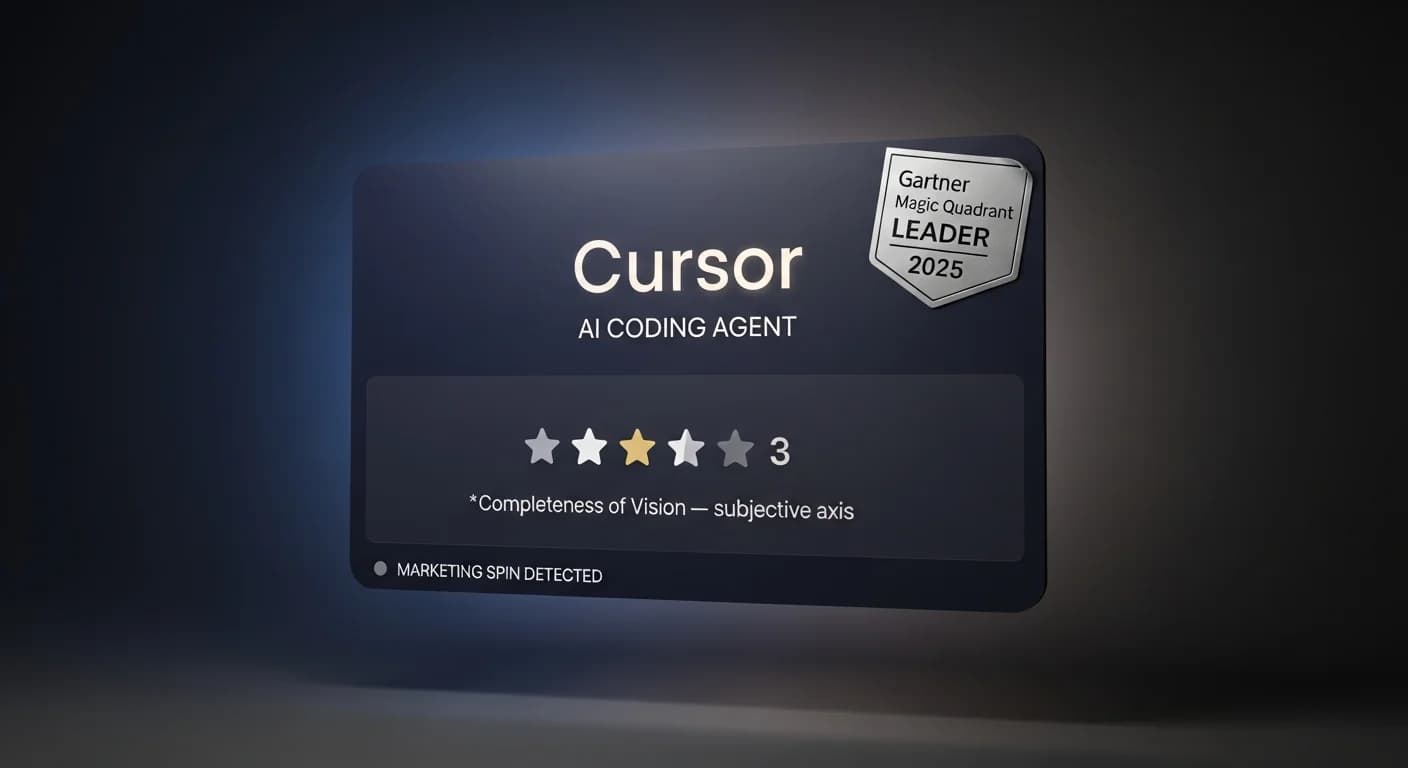
Cursor got named a Leader in Gartner's first Magic Quadrant for enterprise AI coding agents, with the top score on "Completeness of Vision," and I want to like this more than I do. Not because the product work behind it is bad. It isn't. It's because the announcement is doing the thing every vendor does with an analyst badge: treating a subjective, vendor-briefed axis as if it were a lab result.
Here's what actually happened. Gartner scores companies on two things: whether you can execute (revenue, support, reference customers, mostly verifiable) and whether your roadmap looks like the future (largely a function of how well you brief the analyst). Cursor won the second one. That's genuinely impressive as a communications feat. It is not the same claim as "Cursor's product is the best one." Those two things get conflated in every Magic Quadrant press cycle, and this one is no exception.
What actually earned that vision score is worth more attention than the badge itself. Design Mode, where you can point at a broken button instead of typing a paragraph describing it, is a real usability unlock (Cursor just gave developers a smarter way to tell AI…). The mobile app that lets you queue an agent task from your phone between meetings changes when coding actually happens, not just where (Cursor just turned your iPhone into a serious coding machine). The enterprise access controls and MCP marketplace stuff is boring to write about and exactly what gets a security team to sign off (Cursor's team marketplaces get MCP servers and…). I'd rather read a thousand words on any of those than one more paragraph about quadrant positioning.
Then there's the 70%-of-Fortune-500 line, which is the part I keep coming back to. It's technically true and functionally meaningless without a denominator that actually matters. One engineer with a free license at a 50,000-person company counts the same as a company-wide procurement deal in a stat like this, and every vendor knows it, and every vendor uses it anyway because it sounds enormous and nobody fact-checks the methodology in a press cycle. I don't think Cursor is lying. I think Cursor is doing what the entire category does, borrowing the shape of a rigorous claim for a number that's mostly measuring how easy the product is to download without asking IT first.
I don't want to be too cynical about this, because the underlying competition is legitimately interesting. Alibaba's Qoder is betting enterprise developers want to see the agent's reasoning, not just trust a clean interface (Alibaba's Qoder shows developers what the AI is…). Moonshot.ai's Kimi Code CLI just proved itself on an actual 600-file production refactor, which tells you more about reliability than any analyst briefing does (600 files, one command: what moonshot.ai's refactor…). Watching these companies fight over what "enterprise-ready" even means for an AI agent is more useful than watching any one of them win a quadrant.
So here's where I land. The Gartner placement will absolutely help Cursor close deals, because procurement teams love a pre-approved answer to "why this vendor." That's a real, if slightly depressing, feature of how enterprise software gets bought. But if you're actually trying to decide whether Cursor is the right tool for your team, skip the badge. Go read what it actually shipped. The quadrant is marketing built on top of real engineering. Judge the engineering.