Physical AI
Alibaba's Qwen is now the brain inside 150,000 robots, cars, glasses, and drones
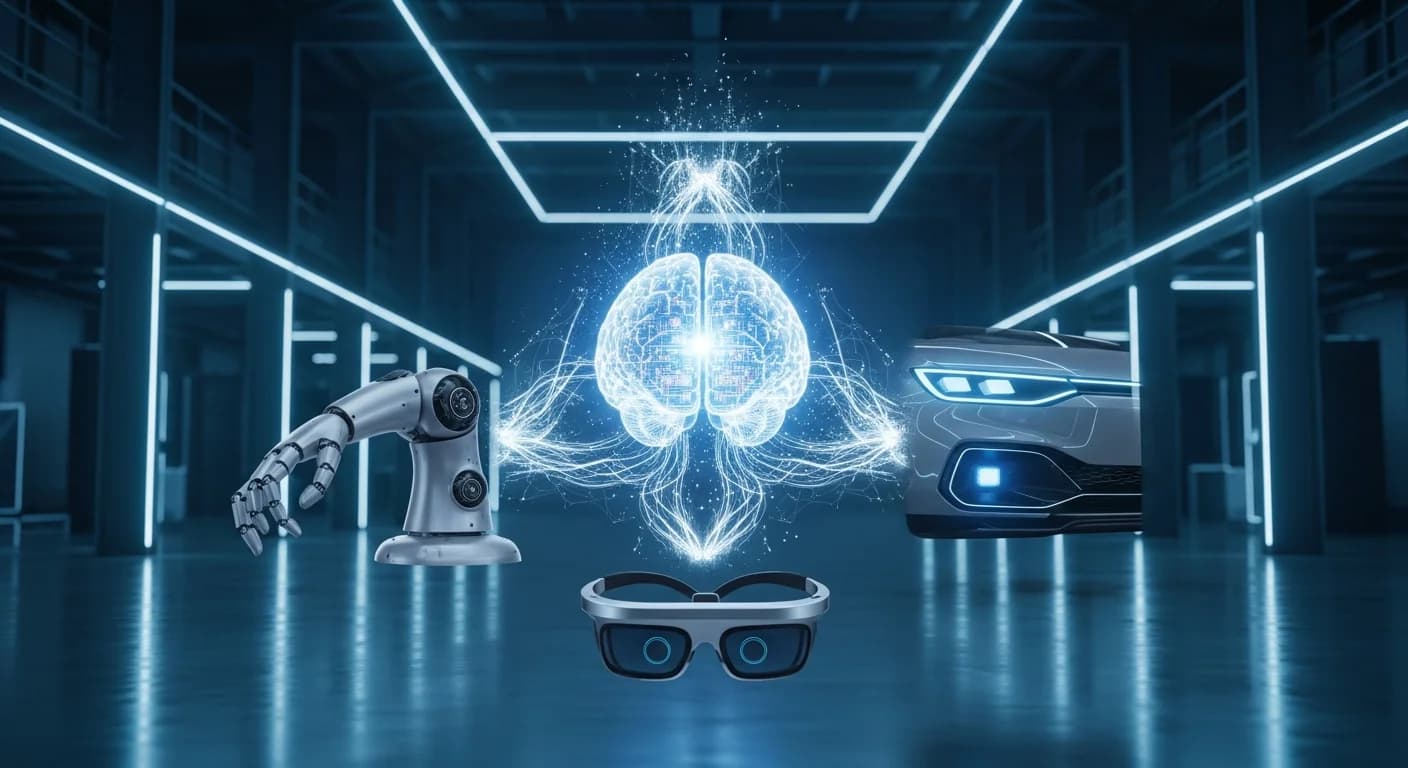
Alibaba's Qwen AI family now powers over 150,000 hardware devices, from humanoid robots to children's cameras, as the company pivots from chatbots to Physical AI, integrating multimodal models into robots, cars, glasses, and drones.
For most of the AI industry's recent history, large language models have lived inside cloud APIs and chat interfaces, processing text and images but never reaching out to touch the physical world. That boundary is dissolving faster than many analysts anticipated. The subtle trap waiting for AI agents in production
Alibaba's Qwen model family, long known for competitive text and multimodal benchmarks, has quietly become one of the most widely deployed AI foundations for physical hardware. With over 150,000 smart device manufacturers in China now integrating Qwen, spanning humanoid robots, smartphones, smart glasses, drones, and children's learning devices, the company is executing a Physical AI strategy that threatens to outflank Western competitors who remain largely focused on software-only AI assistants. meta-ai-open-source-bet
From bits to bodies
The shift became concrete in June 2026 with the launch of the Qwen-Robot Suite, a set of three foundation models specifically designed for embodied intelligence. Unlike general-purpose multimodal models that understand images and text, these models are built to translate perception into action.
Qwen-RobotManip handles object manipulation via a Vision-Language-Action (VLA) architecture. Qwen-RobotNav enables spatial navigation and path planning. Qwen-RobotWorld acts as a video world model that simulates physical dynamics, letting a robot predict what happens if it pushes a cup or opens a door. Together, they aim to solve a problem that has plagued robotics since the field began: getting machines to reliably execute language commands in unfamiliar environments with objects they have never seen before. Fast-LeWM: Parallel Action-Prefix Prediction Slashes…
Early benchmark results suggest the approach works. The suite tops the RoboChallenge leaderboard, a large-scale benchmark for real-robot embodied intelligence, and has entered pilot testing with select Alibaba Cloud enterprise customers in the robotics sector.
The LimX example
One of the most visible integrations is in humanoid robotics. LimX Dynamics, a Shenzhen-based company, recently unveiled LimX Luna, a full-size interactive humanoid robot standing 160 centimeters tall with 27 degrees of freedom. Luna uses Qwen Omni, a multimodal variant, to process visual and audio inputs simultaneously, allowing real-time speech and gesture interaction.
The robot can learn new motor tasks, such as dance movements, by analyzing video clips, then executing them. Behind the scenes, LimX trained its proprietary VLA model on 1.5 petabytes of data, using Alibaba Cloud's PAI machine learning platform and edge computing infrastructure. The two companies jointly developed the FluxVLA Engine, an end-to-end platform for deploying embodied intelligence applications, now hosted on Alibaba Cloud. Nvidia just gave every robotics lab the same 10-point boost
More than robots
Alibaba's hardware reach goes far beyond humanoids. Dr. Look.AI, an interactive AI learning camera for children, upgraded from a simple object recognition tool to a multimodal AI companion using Qwen. It now processes over 50 million photo recognitions per month across 20 countries, serving more than 250,000 users. The device offers personalized storytelling and visual reasoning based on whatever a child photographs.
In the smartphone sector, OPPO is using Alibaba Cloud's PAI platform for post-training Qwen models, while Honor reports a nearly 40% improvement in visual question-answering accuracy after integration. Ecovacs, whose robots serve 38 million households globally, uses a hybrid architecture: edge-sized Qwen models handle intent recognition on device, while larger cloud-based models manage complex dialogue. Drone maker Insta360 uses Qwen for intelligent video production, and smart glasses company Rayneo leverages the model for real-time visual question-answering on the V3 frame.
The infrastructure play
What makes this push strategically different from competitors is the infrastructure layer underneath. Alibaba Cloud provides the compute, storage, and security backbone for the entire hardware ecosystem. Its global infrastructure footprint allows hardware startups to deploy training and inference workloads without building their own data centers. The next trillion-dollar bottleneck in AI isn't…
The company also announced related infrastructure moves that reinforce the Physical AI narrative. At Flink Forward Asia 2026, Alibaba Cloud pushed Apache Flink toward "agentic streaming", real-time data pipelines designed to feed AI agents. The upcoming Flink 3.0 shifts from cloud-native to AI-native, enabling live data to flow directly into agents for instant response. Separate product launches include STAROps, an AI-native global operations platform using agents for autonomous IT management, and AgentLoop, a self-evolution platform that lets enterprise agents improve with use.
Broader implications
Alibaba is not alone in betting on Physical AI. Nvidia has long championed the concept with its Isaac robotics platform, and Tesla is developing humanoid robots for factory automation. But Alibaba's approach differs in two key ways: breadth of hardware partners and openness of models.
Qwen is available in over 400 open-source versions, spanning sizes from 0.5 billion to 480 billion parameters and supporting text, image, video, and audio modalities. That diversity lets hardware makers pick a variant that fits their compute budget, an edge-sized model for smart glasses, a mid-range model for a robot vacuum, a full-scale model for cloud-based reasoning. Western competitors like Anthropic and OpenAI have largely kept their most capable models proprietary and cloud-only. OpenAI's GPT-5.6 is here. The part that should keep you…
Whether Qwen's hardware ecosystem can translate into durable competitive advantage remains an open question. But the numbers are already striking: 150,000 manufacturers, 250,000 users on a single application, tens of millions of monthly inferences on consumer devices. For a model family that started as a text-only LLM two years ago, the trajectory into Physical AI is accelerating. Alibaba's Qwen is building a model for every AI job,…