Robot Learning
Nvidia just gave every robotics lab the same 10-point boost
Nvidia's GR00T 1.7 VLA model integrates into LeRobot for end-to-end robot learning, from VR or leader-arm data collection to fine-tuning and deployment. Benchmarks show a leap from 87% to 96.5% success on LIBERO tasks, and the open pipeline runs on commodity hardware.
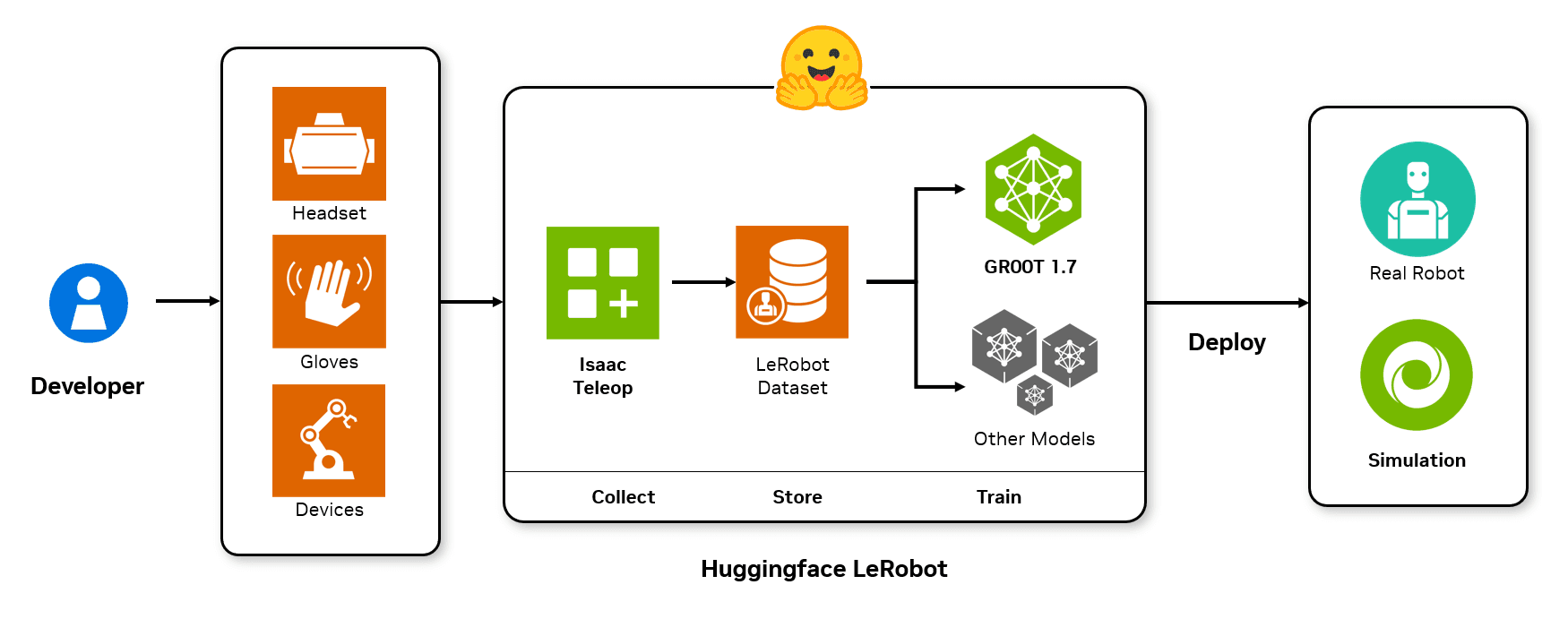
Until recently, training a general-purpose humanoid robot to pick up a vial and place it in a rack meant buying expensive specialized hardware, wrangling proprietary software stacks, or relying on simulation environments that rarely transfer cleanly to the real world. Nvidia's release of GR00T 1.7 on LeRobot, paired with the Isaac Teleop framework, collapses that funnel into a single open-source workflow that any lab with an SO-101 arm and a GPU can run.
What changed
GR00T 1.7 is a Vision-Language-Action foundation model for humanoid robots. It ingests camera frames and a language instruction, then outputs joint-level action sequences. The model replaces GR00T N1.5 in the LeRobot ecosystem, which means teams already using LeRobot can swap models without re-engineering their pipeline. Isaac Teleop provides two data-collection paths: a VR headset with hand controllers, or the SO-101 leader arm. Both record demonstrations in a format that LeRobot's training scripts consume directly.
Data quality and quantity remain the dominant bottleneck in robot learning. Proprietary systems from Boston Dynamics or Tesla produce polished demos but lock researchers out of the loop. LeRobot, an open-source framework from Hugging Face, already hosts hundreds of demonstration datasets. By plugging GR00T 1.7 into that ecosystem, Nvidia is betting that open data pipelines will accelerate humanoid development faster than any single lab's closed efforts.
Benchmark reality check
The numbers released with GR00T 1.7 are striking. On the LIBERO benchmark suite, which covers 130 tabletop manipulation tasks that test spatial, object, goal, and long-horizon generalization, the model averaged 96.5% success, up from 87% for GR00T 1.5. The biggest jump was in LIBERO-Spatial, from 82% to 95%. LIBERO-Object hit 100%, and LIBERO-Long, which tests the model's ability to chain multiple steps, climbed from 82% to 93%.
These figures should be read with the nuance they deserve. LIBERO tasks are conducted in a controlled tabletop setting with a single robot arm, not a dynamic humanoid walking and grasping in the wild. The benchmark measures fine-tuning after pre-training, not zero-shot generalization from the base model. Still, the improvement trajectory is credible. An almost ten-point average gain in one generation suggests the architecture and training recipe are scaling effectively.
Open stack, real hardware
Nvidia publishes the GR00T 1.7 weights under an open model license on Hugging Face (nvidia/GR00T-N1.7-3B), and the LeRobot integration handles installation, training, and deployment with a few commands. The workflow is straightforward: install LeRobot with the GR00T extras, collect 50 episodes of demonstration data via Isaac Teleop, fine-tune for 20,000 steps on an RTX 6000 Pro (or multi-GPU via accelerate), then deploy with lerobot-rollout. The company also provides a one-click Brev instance for cloud GPU training.
The data-collection side is where the release adds real surface area. Isaac Teleop supports both VR headsets and the SO-101 leader arm, a low-cost serial motor arm sold for research. That dual path matters. VR provides intuition for human-like demonstrations, while the leader arm lets researchers precisely control joint-level trajectories. Both produce LeRobot datasets that push directly to the Hugging Face Hub.
Nvidia also signals that DGX Spark users, essentially developers running locally on specialized Nvidia hardware, get optimized CUDA 13 torch builds. The ecosystem is clearly designed to reduce friction for teams that already bet on Nvidia's hardware, but the open-source nature of LeRobot means AMD and Apple Silicon users can still participate, albeit without the same speed guarantees.
What the release doesn't say
Two questions remain unanswered. First, the GR00T 1.7 model is a 3-billion-parameter transformer, which places it in the same compute class as many small LLMs. It is fine-tunable on a single high-end GPU but not on a laptop. Nvidia does not publish inference latency figures for the model on its own hardware, making it hard to assess real-time feasibility on lower-cost robots like the SO-101.
Second, the benchmark results all come from the same LeRobot workflow and robot type. Generalizing to different kinematic chains, camera configurations, or environments will require additional fine-tuning. Nvidia frames this as a feature, the whole point of LeRobot is adaptation, but it also means the 96.5% success rate is an upper bound, not a guarantee.
The broader picture
Nvidia's play here is not to build the best humanoid robot, but to own the software platform that every humanoid robot will run. By making GR00T 1.7 accessible through LeRobot, the company undercuts specialized robotics middleware and positions its hardware, from the RTX 6000 Pro to the DGX Spark, as the default training infrastructure. Competitors like Google's Open X-Embodiment and Meta's work on embodied AI offer alternative approaches, but none have tied data collection, fine-tuning, and deployment into a single open pipeline with as little friction as this release demonstrates.
For academic labs and startups building on SO-101 or similar arms, the path from demonstration to functional policy just got dramatically shorter. Whether that translates into better general-purpose humanoids in the wild depends on how many teams actually collect the 50-episode datasets needed to fine-tune, and how well the model transfers when the table, the lighting, or the vial changes.