Open Source & Local AI
How Local LLMs Like Gemma and Qwen Are Taming Open Source Repository Triage at Scale
A maintainer's deep dive into replacing costly cloud-based triage with local open-weight models on an NVIDIA GB10 reveals that models like Gemma 4 and Qwen 3.6 can achieve F1 scores above 0.80 on real-world issue classification. The system uses an agent harness, a restricted read-only shell, and structured outputs to deliver near-instant notifications with zero API spend.
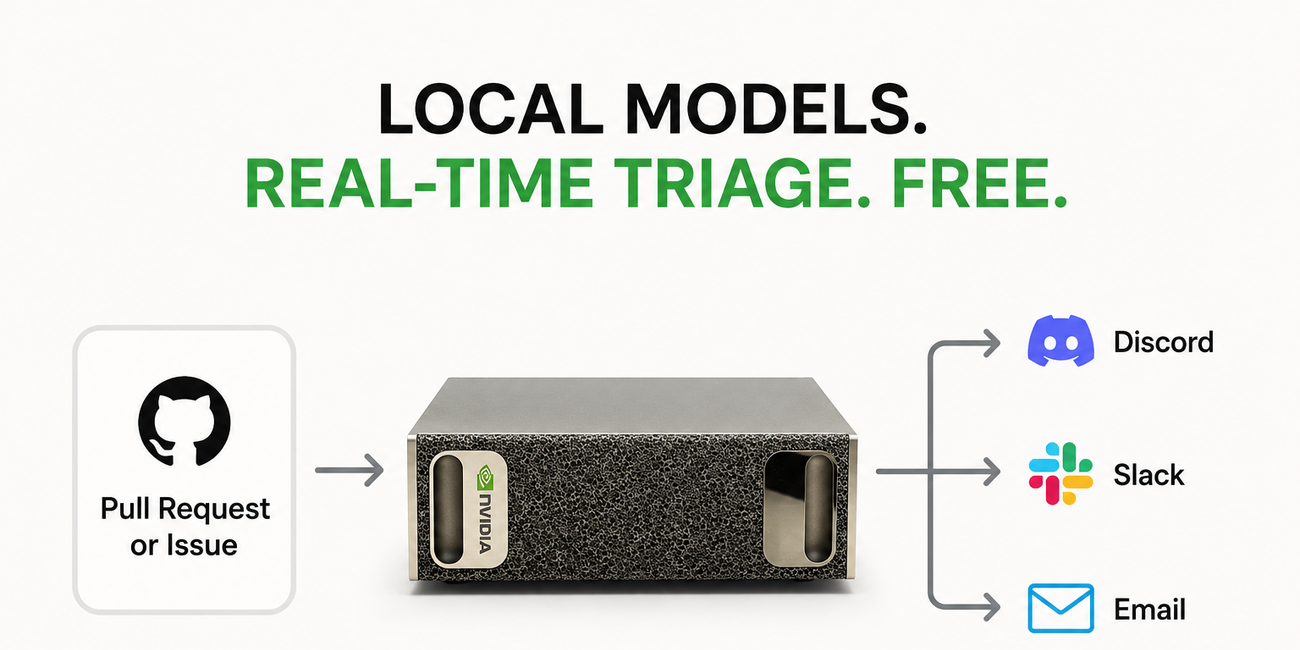
When Anthropic yanked Claude Fable 5 in June 2026, it sent a chill through the developer community: if you build on closed AI, you live by their rules. For teams that depend on AI for core operations, like triaging a firehose of open-source issues, owning the stack and running models on local hardware is no longer a luxury. It’s survival.
A recent technical deep-dive from the OpenClaw maintainer community, authored by Onur and shared as a detailed walkthrough, offers a compelling case study in how local open-weight models can elbow out expensive cloud classifiers for high-throughput triage. The test bed: the OpenClaw repository itself, which processes hundreds of issues and pull requests every day.
The Problem: Real-Time Triage Without Breaking the Bank
OpenClaw maintainers live and die by their reaction time to P0 issues. Firing up a state-of-the-art closed model like GPT-5 or Opus via a ChatGPT Pro plan ($200/month) makes triage straightforward, but it’s expensive and quota-bound. Batching issues every few hours kills real-time responsiveness. Running a local model on existing hardware, in this case, an NVIDIA GB10 with 128 GB of unified memory, delivers near-instantaneous alerts for little more than the cost of electricity.
The Architecture: Semi-Agentic Classification
The system, called localpager, strings together a tidy pipeline:
- Ingestion: OpenClaw’s gitcrawl mirrors the repo locally; each new issue or PR is normalized and stashed in a SQLite database.
- Classification jobs: A worker builds a GitHub context object (title, body, labels, diff excerpts, comments) and passes it to an agent harness.
- Agentic labeling: The agent runs a local model via Pi harness, with tools for read-only repo exploration (reposhell) and structured output submission (final_json).
- Notification: Deterministic rules relay classified results to Discord based on user-defined policies.
Security gets a hard look here: the agent uses reposhell, a restricted read-only shell that mimics bash but blocks all write operations. This keeps prompt injection from steering a local model into mischief during high-throughput runs.
Models Tested: Gemma 4 vs. Qwen 3.6 vs. DeepSeek-V4-Flash
Three models went head-to-head on a 330-row dataset of GitHub issues and PRs. Labels were created by aggregating five runs from GPT-5.5 and Opus 4.8, with hand adjudication. The results tell a nuanced story:
| Metric | gemma-4-26b-a4b | qwen3.6-35b-a3b | DeepSeek-V4-Flash |
|---|---|---|---|
| Precision | 0.716 ± 0.010 | 0.831 ± 0.007 | 0.938 |
| Recall | 0.905 ± 0.004 | 0.818 ± 0.006 | 0.714 |
| F1 | 0.800 ± 0.008 | 0.824 ± 0.002 | 0.811 |
| Exact match | 0.410 ± 0.014 | 0.540 ± 0.014 | 0.509 |
| Wall seconds / row | 1.41 ± 0.04 | 13.51 ± 0.79 | 144.14 |
| Concurrency | 16 | 4 | 1 |
Key takeaways:
- Gemma shines on recall and throughput (1.41 seconds per row at concurrency 16), ideal for catching everything, but it comes with more false positives.
- Qwen takes the precision crown and exact match, with fewer false positives, though it runs slower (13.5 seconds per row).
- DeepSeek-V4-Flash (284B parameters) posts the highest precision but is a non-starter for real-time use on this hardware, 144 seconds per row and only concurrency 1.
The Gemma benchmark used NVFP4 quantization on GB10 Blackwell hardware, notching over 700 output tokens per second at concurrency 32 in separate tests.
Validation: An Audit Loop With GPT-5.5
To keep trust in local model performance, the team runs both the local classifier and a GPT-5.5 job every two hours. GPT-5.5 labels the same items, and a script flags false positives and negatives. This audit loop consumes roughly 40,000 GPT-5.5 tokens per check, costing about 2 to 3 cents per run, roughly $9/month at 12 runs per day. That’s a fraction of a $200/month Pro plan.
Results show the local models catch most priority items, with false negatives flagged for manual review.
Beyond Open Source: High-Throughput Triage's Broader Potential
The authors argue this approach, call it agentic classification, generalizes well to domains like news categorization, social media filtering, customer support ticketing, content moderation appeals, sales lead filtering, and arXiv paper discovery. The combination of a fast local model, a restricted read-only shell, and a structured output schema provides a reusable recipe.
"We think that the issue/PR triage task is a specific case of a broader set of tasks which we call 'high throughput triage'. The ability of medium-sized local models like gemma-4-26b-a4b and qwen3.6-35b-a3b to zero-shot classify with good accuracy without any need for fine-tuning makes them a good first choice for quick prototyping."
Conclusion
This case study makes one thing clear: local open-weight models are no longer a compromise. With the right agent harness, security tooling, and hardware, they can go toe-to-toe with cloud models on recall, precision, and latency, while giving teams complete ownership and zero ongoing API costs. As the AI landscape grows more volatile, the ability to run your own stack is becoming a competitive advantage.