Portfolio strategy
Alibaba's Qwen is building a model for every AI job, not just one to rule them all
Alibaba Cloud's Qwen team quietly released a 35B MoE agent world model, three new ASR models, and an image-generation RL report, revealing a strategic bet on breadth over spectacle in the AI model race.
The Qwen organization on Hugging Face has long been the staging ground for Alibaba Cloud's open-weight strategy. Browsing the repository now, you get a sense of disciplined expansion rather than something breathless and one-off. Of the 458 models and 33 Spaces listed, a few stand out as signposts for where Qwen is headed next.
Qwen-AgentWorld-35B-A3B: a lightweight brain for heavy agent tasks
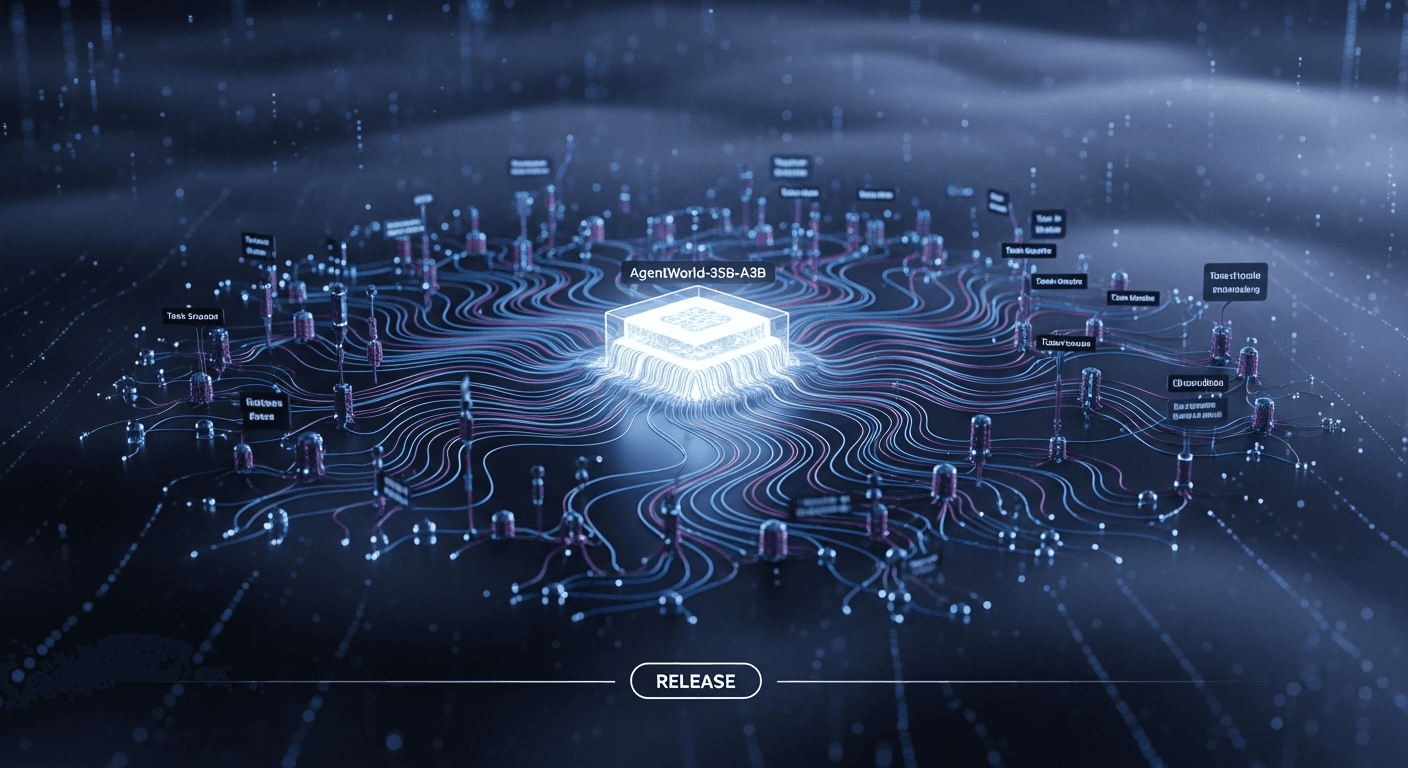
The most notable addition is Qwen-AgentWorld-35B-A3B, a 35-billion-parameter mixture-of-experts model that activates only 3 billion parameters per token. The inference cost is roughly that of a 3B dense model, but the full 35B knowledge base gives it a capacity that older open-weight agent models cannot touch.
The model is built for real-world agent loops: tool use, multi-step planning, and environment grounding. The AgentWorldBench dataset (2.17k downloads, 1.86k likes) is the evaluation harness, and the WebWorldData dataset (463k samples) provides the synthetic training material. Together, they form a complete pipeline for training and measuring agentic AI, something few labs share alongside their weights.
The 35B-A3B design follows the same philosophy as Qwen3's earlier MoE releases: dense knowledge, sparse compute. The shift in application, from general text generation to interactive agent behavior, suggests Alibaba sees agent reasoning as the next frontier where parameter count and inference cost both matter.
Qwen3 goes to speech: ASR and TTS models emerge
Three new speech models have appeared in the repository: Qwen3-ASR-0.6B-hf (automatic speech recognition, 600 million parameters), Qwen3-ASR-1.7B-hf (1.7B), and Qwen3-ForcedAligner-0.6B-hf (a 0.9B token classification model for phoneme alignment). The ASR models have drawn significant attention, the 0.6B variant has 23.7k downloads, and its larger sibling has 8k.
On the text-to-speech side, the Qwen3-TTS Demo Space with 2.01k runs offers voice generation from text prompts, supporting voice design, cloning, and presets. This is Alibaba's clearest entry into the voice AI market, a space increasingly crowded by ElevenLabs, OpenAI, and open-source projects like Coqui TTS. The Qwen3 TTS models are not yet listed as standalone downloads, the Space is the only public interface, but the family's trajectory points to formal releases soon.
Image generation gets a reinforcement learning upgrade
The Qwen-Image-2.0-RL Technical Report dropped alongside the new Spaces, describing how reinforcement learning from human feedback (RLHF) was applied to the image generation pipeline. The Qwen-Image-Bench model (27B parameters, 29.5k downloads) serves as the image-text-to-text backbone, while the Qwen Image Space (912 runs) and its variant Qwen Image 2512 (376 runs) let users generate and edit images through conversational instructions.
The combination of image generation, editing, and prompt rewriting (Qwen Image 2512) in a single product line mirrors the strategy at Midjourney and Adobe Firefly, but with the crucial difference that all weights are open. For enterprise users building custom visual pipelines, the availability of base models and the RL recipe removes the black-box risk.
The image generation pipeline also includes a dedicated safety guard: the Qwen3GuardTest dataset (2.44k samples, 2.38k likes) provides red-teaming material for evaluating model refusal behavior. Together, the safety and vision datasets make it clear that this organization treats evaluation infrastructure as a first-class product, not an afterthought.
Evaluation datasets as infrastructure
Qwen's dataset roster now includes 10 evaluation benchmarks, several of which have become community standards. DeepPlanning (2.14k samples) tests long-horizon planning. PolyMath (9k samples) targets multi-step mathematical reasoning. CodeElo (408 samples) offers competitive programming evaluation. ProcessBench (3.4k samples) and P-MMEval (19.7k samples, the largest) both focus on process-level reward modeling for math and coding.
The RationaleRM dataset (441 samples) is the most interesting of the batch: it gives rationale-based preference data for reward model training. Some researchers argue this technique improves model alignment more efficiently than standard pairwise preference comparisons.
This evaluation-first approach is rare among Chinese AI labs. Most competitors release a model and a vague benchmark score; Qwen releases the model, the training data, the evaluation harness, and often the reward model itself. For practitioners building on top of these models, that transparency cuts down the guesswork in fine-tuning.
The strategy behind the catalog
Qwen's Hugging Face presence now covers seven capability domains: pure language (Qwen3), speech recognition (ASR), text-to-speech (TTS), image generation (Qwen-Image), image editing (Qwen-Image-Edit), agent reasoning (Qwen-AgentWorld), and safety alignment (Qwen3Guard). The model sizes range from 600 million parameters to 35 billion, with both dense and MoE architectures.
What is missing is as revealing as what is present. There is no single 'Qwen4' model dominating the catalog, no GPT-4 or Claude 4 equivalent demanding all attention. Instead, Qwen is building a portfolio of specialized models that can be assembled into solutions for different deployment profiles: a lightweight ASR model for edge devices, a 35B agent model for autonomous workflow automation, and a 27B vision model for generation and editing.
This fragmented catalog may look like chaos. It looks, instead, like a deliberate bet that the future of AI is not one model to rule them all, but a family of interoperable models, each tuned for a specific cognitive mode, joined by shared evaluation, safety, and inference infrastructure.