Special Report
OpenAI's gpt-5.6 launch rewrites the economics of frontier ai
OpenAI's GPT‑5.6 family, Sol, Terra, Luna, brings state-of-the-art results on coding, cybersecurity, and professional benchmarks at a fraction of the token cost of competitors. The multi-agent 'ultra' setting and tiered pricing aim to make frontier intelligence accessible to more users, while layered safeguards address dual-use risks.
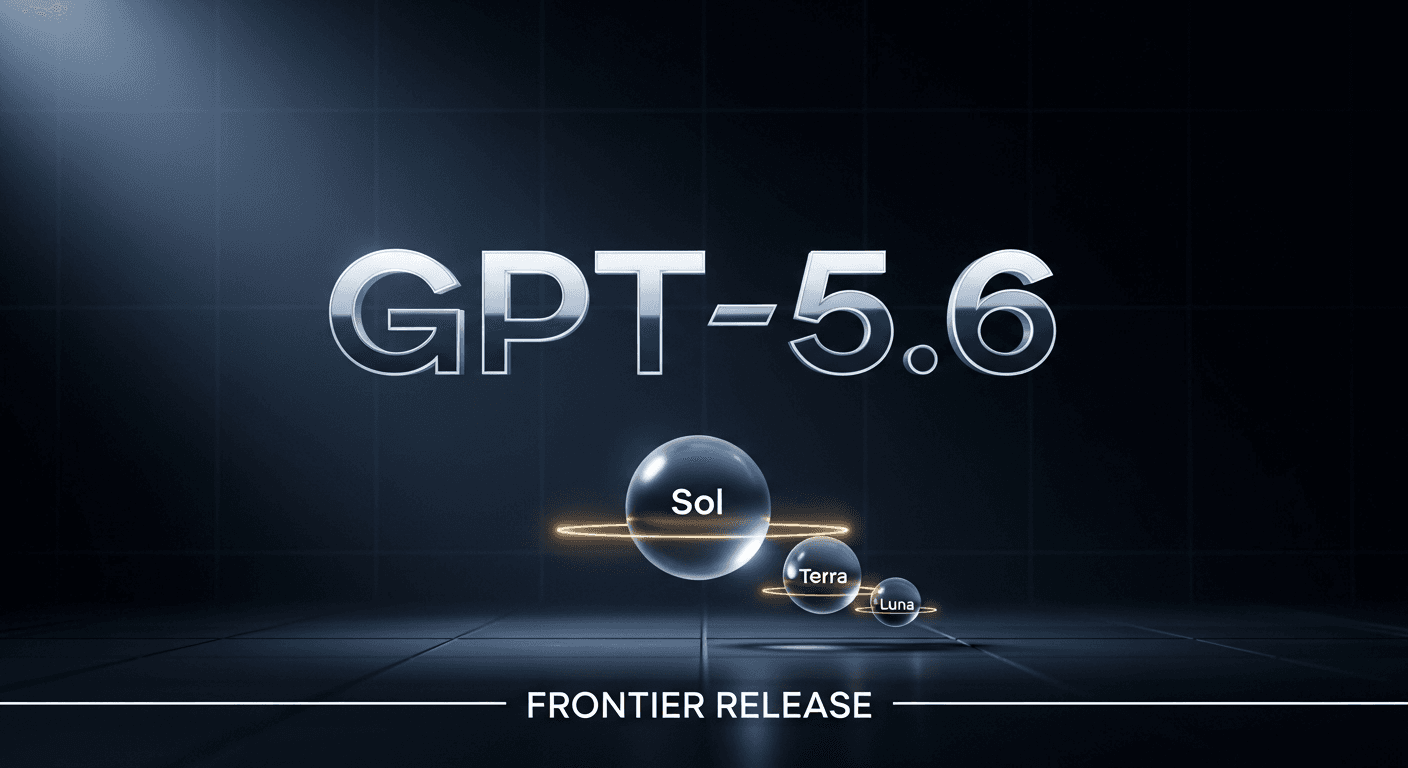
OpenAI has turned the AI hardware race on its head, not by building a bigger model, but by making every token count harder. The GPT‑5.6 family, announced today after a limited preview, introduces three tiers, Sol, Terra, and Luna, that collectively outperform their predecessors and rivals on a battery of benchmarks while consuming far fewer tokens and dollars. The release signals a strategic shift: efficiency, not raw scale, is now the battleground.
A three-tier strategy for a smarter market
GPT‑5.6 splits into distinct capability levels. Sol, the flagship, aims at the hardest problems: complex code generation, professional analysis, and multi-hour agent workflows. Terra targets balanced performance for everyday knowledge work, and Luna is built for maximum cost-efficiency. All three are available today across ChatGPT, Codex, and the OpenAI API, rolling out globally over 24 hours.
The pricing reflects this tiering. Sol costs $5 per million input tokens and $30 per million output tokens; Terra is $2.50 / $15; and Luna is $1 / $6. For applications that require heavy inference, the difference between Luna and Sol can be as much as 5× on input and 5× on output, a deliberate gap that lets developers optimize for cost without leaving the GPT ecosystem.
Efficiency as a weapon
The headline numbers come from the Agents' Last Exam, a benchmark of long-running professional workflows across 55 fields. GPT‑5.6 Sol scores 53.6, 13.1 points above Anthropic's Claude Fable 5 at adaptive reasoning. More striking: even Sol's medium-reasoning setting beats Fable 5 by 11.4 points at roughly one-quarter the estimated cost. Terra and Luna outperform Fable 5 at approximately one-sixteenth the cost.
On the Artificial Analysis Intelligence Index, which bundles agentic work, coding, and scientific reasoning, Sol with max reasoning finishes within one point of Fable 5 while completing tasks 61% faster at roughly half the cost. "We trained GPT‑5.6 to get more useful work from every token," the company wrote in its announcement.
Coding at the frontier
Coding benchmarks reveal the efficiency advantage most starkly. On the Artificial Analysis Coding Agent Index, Sol with max reasoning sets a new state of the art at 80, 2.8 points above Fable 5, while using less than half the output tokens, taking less than half the time, and costing one-third less. Terra sits just above Fable 5, and Luna surpasses Anthropic's Opus 4.8, each at roughly one-quarter the cost.
OpenAI also introduced Programmatic Tool Calling in the Responses API, allowing GPT‑5.6 to write lightweight programs that coordinate tools, process intermediate results, and adapt workflows without requiring developers to script every step. The feature is compatible with Zero Data Retention, a nod to enterprise compliance needs.
The multi-agent accelerator
For problems that reward more compute, GPT‑5.6 introduces two new settings: max gives the model extra reasoning cycles, and ultra coordinates four agents in parallel by default, trading higher token consumption for stronger results and faster time-to-result. On BrowseComp, ultra with four agents achieved 92.2%, a new state of the art, and on SEC-Bench Pro it scored 74.3%, up from Sol's solo 71.2%. The company released charts showing that adding parallel agents shifts the score-latency frontier upward and to the left.
In the API, developers can replicate ultra-like experiences through a multi-agent beta. "Ultra goes further by coordinating four agents in parallel by default, trading higher token use for stronger results and faster time-to-result on demanding tasks," OpenAI noted.
Cybersecurity: a dual-use tightrope
The cybersecurity improvements are among the most significant, and most sensitive. On ExploitBench, Sol scored 73.5% versus GPT‑5.5's 47.9% at a comparable output-token budget. On ExploitGym, it nearly doubled GPT‑5.5's peak pass rate, from 15.1% to 24.9% under a two-hour cap, extending to 33.7% with six hours.
OpenAI acknowledged the dual-use nature of these capabilities. "In cybersecurity, the same capabilities that could help an attacker exploit a vulnerability can help a defender find it, reproduce it, and build a reliable fix," the company wrote. "Overblocking therefore creates a security risk of its own."
To manage the risk, GPT‑5.6 ships with layered safeguards including a reasoning monitor that reviews conversations for harm potential. Before general availability, OpenAI ran approximately 700,000 A100e GPU hours of black-box automated red teaming and extensive external testing. A new Trusted Access for Cyber program lets verified individuals and organizations access more of the model's defensive capabilities.
The company also warned that GPT‑5.6's cyber safeguards block roughly ten times more potentially harmful activity than previous models, and that some benign uses may experience friction. A "retry on lower-capability model" option in ChatGPT and Codex aims to reduce that burden.
Knowledge work and design judgment
Beyond raw benchmarks, GPT‑5.6 shows gains in practical professional tasks. On OSWorld 2.0, Sol reached 62.6%, surpassing Opus 4.8 while using 85% fewer output tokens. On BrowseComp, Sol scored 92.2%. The family also improves presentation and spreadsheet generation: GPT‑5.6 can infer design systems from reference decks and apply them consistently, and handle financial models with greater precision.
Early customers reported productivity gains. Lovable, an app-building platform, noted that GPT‑5.6 "delivers for users with roughly 25% fewer steps and 35, 48% fewer tool calls than the prior model, while improving project success and reducing stuck runs by 15%." Qodo, a code review tool, found GPT‑5.6 "beat GPT‑5.5 on F1 while using roughly 3× fewer tokens per PR and delivering about 2× lower median latency."
Self-improvement: the internal flywheel
Inside OpenAI, the model is already accelerating research. Daily average output tokens per active researcher during internal testing were more than double the highest level observed for GPT‑5.5. The share of research compute devoted to internal coding inference grew 100‑fold over the past six months, while agentic token usage increased 22-fold.
OpenAI developed an internal RSI Index, recursive self-improvement, bundling evaluations on debugging, kernel optimization, and experiment interpretation. Sol scored 57.9%, a 16.2‑point jump over GPT‑5.5's 41.7%, suggesting the model is measurably better at helping build the next generation of models.
The safety calculus
OpenAI insists GPT‑5.6 does not cross the "Critical" threshold in biology or cybersecurity, the line where a model could independently create novel dangerous threats. The company's testing suggests Sol is better at finding and fixing vulnerabilities than at autonomously attacking hardened targets. In biology, it supports legitimate research but lacks end-to-end capability for highly dangerous novel threats.
The layered safety stack includes trained-in protections, real-time checks, a reasoning monitor, and account-level enforcement. "Because some protections use test-time reasoning, we can rapidly update them to close gaps without retraining classifiers from scratch," the company said.
A new rapid-remediation process and expanded bug bounty programs for security and biology aim to close gaps as they emerge. But OpenAI was candid about the limits: "There is no such thing as perfect security, and our work to secure increasingly capable models continues. New weaknesses will be discovered, as will new jailbreaks that circumvent existing safeguards."
What the competition means
The launch deepens the already intense rivalry with Anthropic. Claude Fable 5 remains competitive on several benchmarks, particularly in scientific reasoning where it leads on HealthBench Professional (60.9% vs. GPT‑5.6 Sol's 60.5%) and on FrontierMath Tier 4 (87.8% vs. 65.9%). But GPT‑5.6's efficiency gains, especially at the Luna tier, undercut the argument that frontier intelligence requires frontier budgets.
Google DeepMind's Gemini 3.1 Pro Preview and Gemini 3.5 Flash trail on most benchmarks, and the gap appears to be widening on coding and agentic tasks. The release also pressures Meta AI's open‑weight Llama 4 family to demonstrate that open models can match this level of performance per compute.
The GPT‑5.6 family is available now. The question is not whether it's the most powerful model on the market, on several benchmarks it is, but whether its efficiency-first design will force competitors to rethink their own cost structures. If the benchmarks hold in real-world deployment, the era of cheap, abundant frontier intelligence may have just arrived.