AI Agents
Microsoft's bet on small models for agentic AI is about orchestration, not knowledge
Microsoft Research's MagenticLite project shows that small models can handle complex agentic tasks when orchestration, model design, and execution environment are codesigned. The release includes MagenticBrain, a 14B orchestrator, and Fara1.5, a computer-use model family that nearly doubles prior performance on web navigation benchmarks.
Microsoft Research AI Frontiers has released a trio of components that collectively argue a contrarian thesis in the agentic AI space: small models, properly orchestrated, can handle tasks typically reserved for their much larger, more expensive cousins. The release, announced today, includes MagenticLite, an experimental agentic application; MagenticBrain, a 14-billion-parameter orchestration model; and Fara1.5, a family of computer-use models ranging from 4B to 27B parameters.
The claim is not that small models match frontier models on raw reasoning benchmarks. Rather, the project is built around a specific research bet: that agentic capability depends on tool orchestration and action rather than knowledge alone. If that bet holds, it opens a path toward capable agents that can run directly on users' hardware at a fraction of the cost and latency of cloud-dependent large models.
Small models, big orchestration gap
Most agentic systems today rely on large frontier models for the orchestration layer, the component that plans, delegates, and coordinates. Microsoft's design challenges that assumption with MagenticBrain, a 14B model fine-tuned from Qwen 3 14B. The key design decision was training it end-to-end within the MagenticLite harness with the same tool schemas and execution environment it would encounter at inference time.
"There is no gap between how it learned to orchestrate and how it runs," the researchers note in their release. This tight coupling between training and inference is a deliberate departure from the approach taken by many agentic frameworks, where a general-purpose model is prompted into a planning role without the benefit of task-specific training data.
MagenticBrain handles a combination of multistep tool-calling trajectories, coding trajectories, and terminal use. Critically, it also learns delegation: recognizing when a browser or UI task should be handed off to Fara1.5 rather than handled directly. The data pipeline includes explicit delegation trajectories where the orchestrator issues a structured handoff, waits for the result, and resumes the overarching task.
Fara1.5 doubles down on computer use
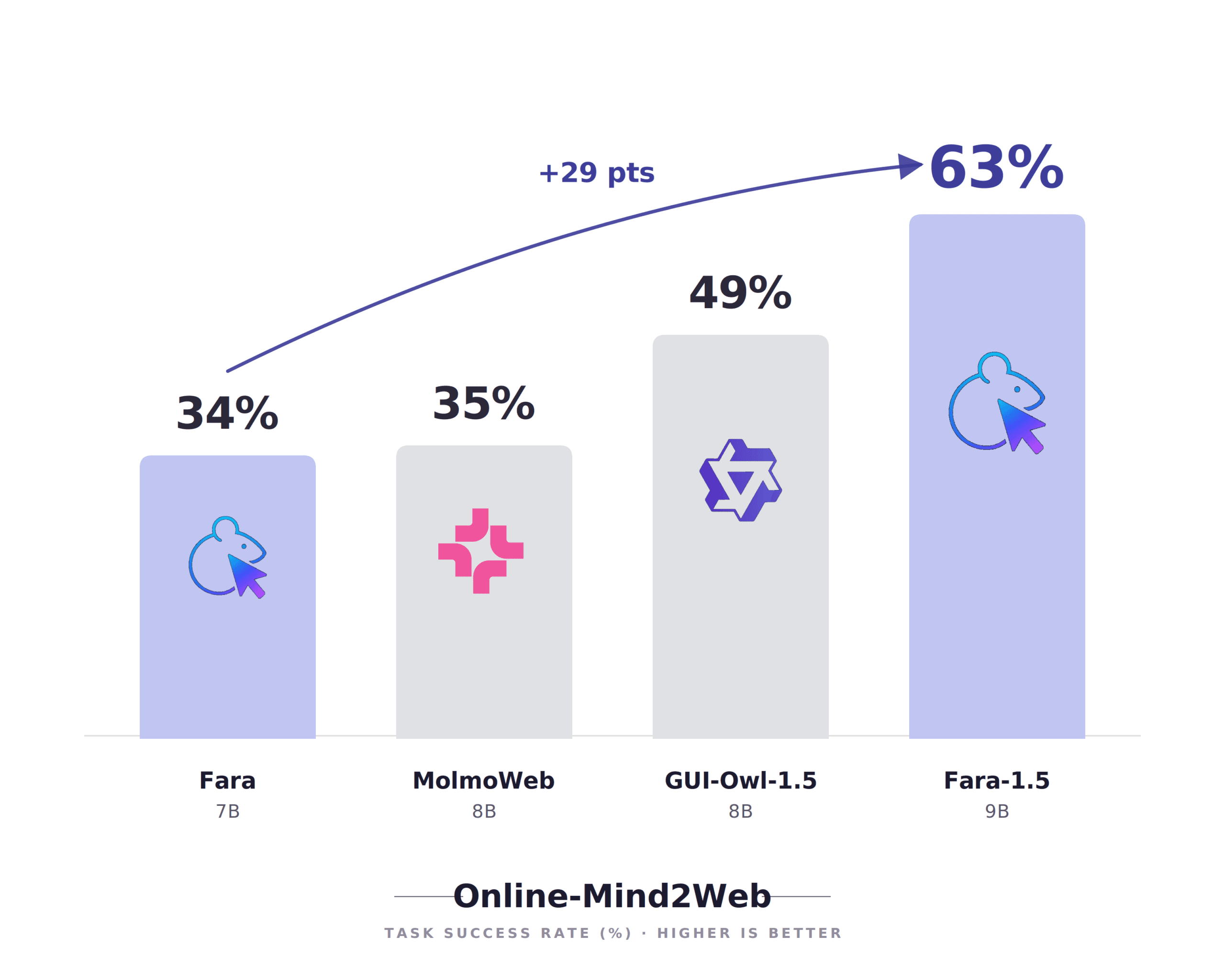
Fara1.5 is the direct successor to Fara-7B, released last November. On the Online-Mind2Web benchmark, which covers 300 tasks across widely used web domains, Fara1.5-9B nearly doubles the performance of Fara-7B. The flagship 27B variant achieves more than 90% performance on the same benchmark.
The improvements come from an evolved data generation pipeline. Alongside training on live websites, the researchers trained the model on highly realistic synthetic environments designed to simulate scenarios like logins and irreversible actions. The model also features a native action space tuned for long-running tasks: built-in tools to store key information in its context across hundreds of steps and ask the user for permission or preferences when needed.
One refinement addresses a tension in earlier work: detecting critical points for transactions, login flows, or irreversible submissions. In Fara1.5, the research team recalibrated safety triggers so they occur when they should but do not block useful tasks such as form-filling. That balance had eluded prior releases.
The harness makes the system
The execution harness that ties MagenticBrain and Fara1.5 together is arguably the component most likely to be overlooked, and the one the researchers emphasize most. Three design choices stand out.
First, the harness plans incrementally rather than all at once. Step-by-step planning keeps the system flexible and enables smoother course correction and recovery throughout long-running tasks. Second, it actively curates context: small models have smaller effective context windows and degrade faster as context grows, so the harness condenses earlier interactions into concise summaries and offloads the rest. Third, delegation through subagents, where the orchestrator passes browser tasks to Fara1.5, allows each model to handle a narrower, more specialized part of the problem.
The entire system runs inside Quicksand, an open-source wrapper for a QEMU-based sandbox that isolates browser sessions and code execution from the host system. Critical points across both browser and code actions pause for explicit user approval, preserving the human-in-the-loop guarantees from the earlier Magentic-UI release.
What this means for the agentic AI landscape
The release arrives at a moment when the industry is debating the optimal architecture for agentic systems. Several high-profile startups and research labs have built agentic frameworks around large frontier models, treating the orchestration layer as a problem best solved by the most capable models available. Microsoft's bet is that this approach conflates reasoning capability with agentic effectiveness.
If the MagenticLite approach holds up under broader community testing, the implications extend beyond cost savings. On-device agents that run on users' own hardware sidestep the data privacy concerns that have shadowed cloud-based agentic systems. They also reduce latency, since the agent's reasoning and action loops execute locally rather than requiring round trips to API servers.
The three model sizes in Fara1.5, 4B, 9B, and 27B, signal an intent to cover a range of hardware configurations, from mobile devices to desktop machines. The 4B variant in particular could plausibly run on current-generation smartphones, though Microsoft has not announced specific hardware targets.
Open questions
The release is experimental, and several questions remain unanswered. The Online-Mind2Web benchmark provides a standard evaluation, but real-world task completion on messy, dynamic websites may differ. The delegation pattern between MagenticBrain and Fara1.5 works for browser tasks, but the system's generality for tasks outside that domain, including file system operations, API calls, and local software automation, remains to be tested.
Microsoft is releasing MagenticLite on GitHub, with MagenticBrain and Fara1.5 available on Microsoft Foundry. The broader community will now be able to test whether the tight codesign of model, harness, and application indeed yields the capable, reliable agentic performance at small scale that the researchers claim.