Perplexity Makes Grok 4.5 Its Top Orchestrator Model in Computer, Beating Opus 4.8 at Half the Cost
Perplexity says Grok 4.5 outperformed five other orchestrator configurations on its internal WANDR benchmark, topping Claude Opus 4.8 in accuracy at roughly half the cost, and is now live in Computer for Pro and Max subscribers.
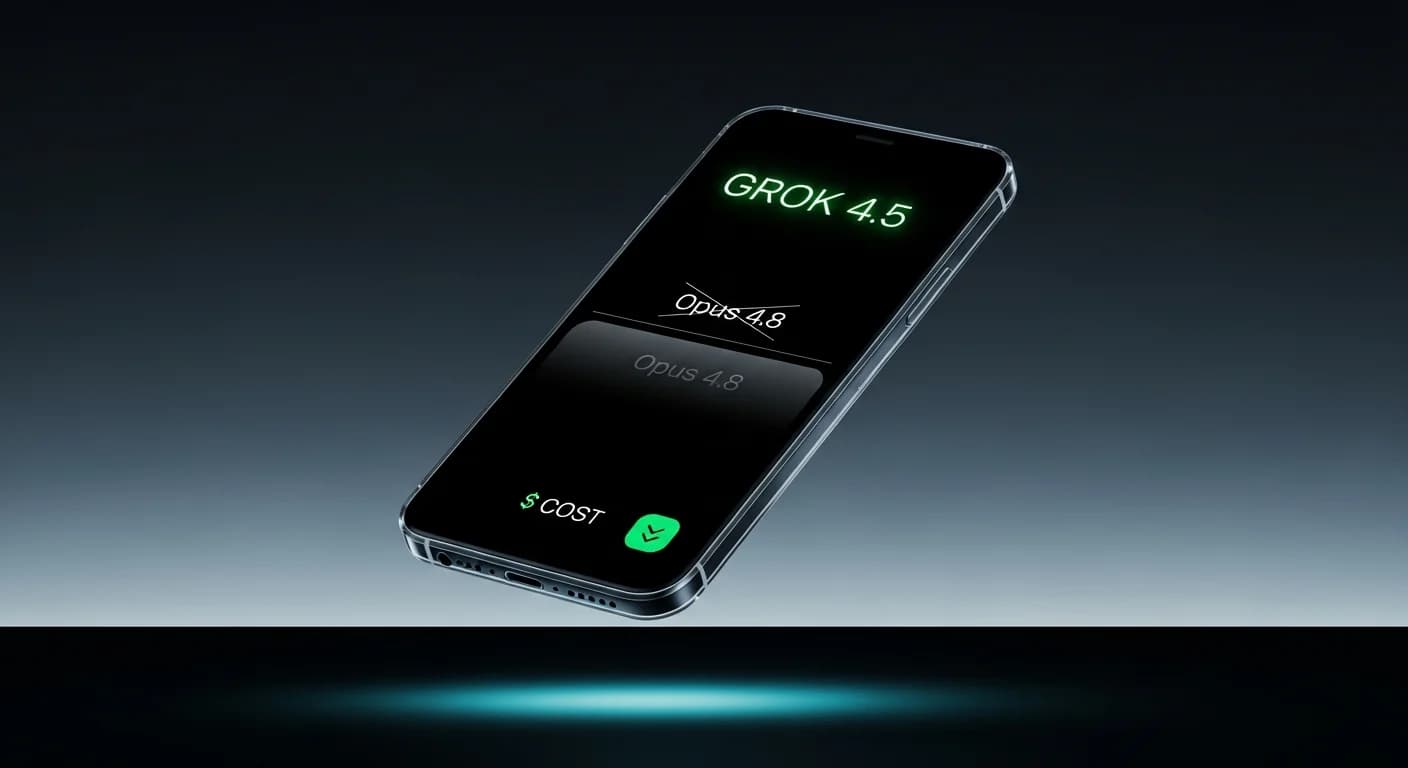
Perplexity announced the update on X on July 10, saying Grok 4.5 (Cursor's Grok 4.5 was built by AI agents, not humans.…) is now available as an orchestrator, the model responsible for planning and coordinating an agent's steps, inside Computer for subscribers on its Pro and Max plans.
The company tested Grok 4.5 against five other orchestrator setups on WANDR, an internal benchmark, and published a cost-performance chart plotting each configuration's score against its price per scored trial. Grok 4.5 topped the chart with a score of roughly 0.328 at $4.76 per trial. Claude Opus 4.8 (Anthropic Releases Claude Opus 4.8 with 1M Context…), run in a high-thinking configuration, scored notably lower at 0.254 despite costing nearly twice as much, $9.46 per trial.
The other configurations Perplexity tested filled out the middle of the cost-performance curve: GLM 5.2 paired with an advisor model scored 0.297 at $4.67 per trial, GPT-5.6 Sol in a medium-effort setting (GPT-5.6 just made every dollar in AI count harder) scored 0.289 at $2.64, plain GLM 5.2 scored 0.207 at $1.74, and GPT-5.6 Terra, the cheapest option tested, scored 0.149 at just $0.40 per trial.
Perplexity did not publish the full WANDR methodology alongside the announcement, so the benchmark's scoring criteria and task set remain unverified outside the company's own testing.