Long-context LLMs
Jet-Long's bifocal attention just killed the fixed-scaling trade-off for long-context LLMs
Jet-Long adapts RoPE rescaling dynamically per sequence length, using a local window and a long-range window merged via inclusion-exclusion. On Qwen3 models up to 128K context, it beats existing zero-shot baselines by over 2 percentage points on RULER and achieves the lowest perplexity on PG-19, all while adding less than 4% generation overhead.
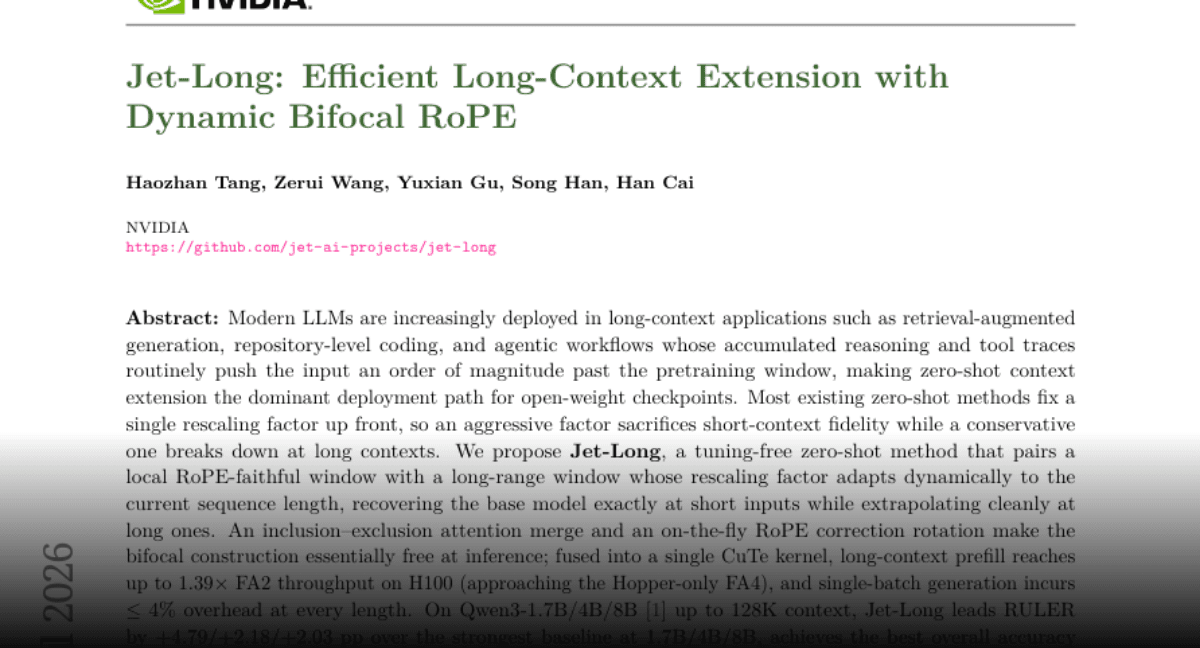
Every LLM deployment that pushes past the training context window runs into the same problem: pick an aggressive RoPE rescaling factor and short inputs degrade; pick a conservative one and the model struggles past some predictable boundary. Most zero-shot context extension methods treat this as a fixed hyperparameter decision, a compromise baked into inference before a single token runs. Your AI model says it can read 1 million tokens. It's…
Jet-Long builds two parallel RoPE windows instead. One sticks to the base frequencies, the other dynamically rescales. They merge through an inclusion-exclusion attention merge paired with a correction rotation that keeps the long-range branch coherent. The result recovers the base model's behavior at short context lengths while extrapolating cleanly as sequences grow. No gradient update needed. Your AI agent passed the test by accident. Now there's…
How bifocal attention sidesteps the fixed-scaling trap
The core idea is simple. Existing zero-shot methods like YaRN, NTK-aware scaling, or linear interpolation pick one rescaling schedule and apply it uniformly across all heads and layers. Jet-Long splits attention into two streams: a local window on the original, unscaled RoPE frequencies preserves short-range positional fidelity; a long-range window uses a rescaling factor l(s) computed from the current sequence length s. As the input grows, the factor slides from near-identity to aggressive stretch, but the base frequencies remain co-active through the merge. The subtle trap waiting for AI agents in production
The merge is the engineering trick. The team derives an inclusion-exclusion formula that combines local and long-range attention scores without double-counting, then applies a RoPE correction rotation that realigns phases across the two branches. This on-the-fly correction, implemented as a fused CuTe kernel on H100 GPUs, makes the bifocal construction effectively free: long-context prefill reaches up to 1.39x the throughput of standard FlashAttention-2, approaching Hopper-only FA4. For single-batch generation, the overhead stays under 4% at every tested length. NVIDIA NeMo AutoModel Delivers 3.7x Faster MoE…
Empirical results that challenge the status quo
The team evaluated the method on the Qwen3 family at 1.7B, 4B, and 8B parameter scales, with contexts extending to 128K tokens. On the RULER benchmark, a long-range recall test, Jet-Long outperformed the strongest baseline by +4.79, +2.18, and +2.03 percentage points at each scale. On the HELMET-RAG benchmark, which the HELMET team found to be the single best predictor of real-world long-context performance, Jet-Long got the best overall accuracy. Perplexity on the PG-19 language modeling dataset was the lowest reported for any zero-shot method at comparable scales. AI models can't stop thinking out loud. That's both…
These gains come without hyperparameter sensitivity. The team reports that Jet-Long stays robust across a wide range of rescaling schedules, a practical advantage for engineers deploying the same checkpoint across different max-context configurations without re-tuning the extension method.
Generalization to hybrid attention architectures
Jet-Long is not locked to pure transformer architectures. The paper shows it generalizes to hybrid attention designs like Jet-Nemotron, where sliding-window and global attention layers coexist. This opens a path for improving long-context capability in models already built with hybrid attention, again without retraining, by swapping the RoPE position encoding at inference time.
For a deployment landscape that increasingly relies on zero-shot extension, with agentic workflows where accumulated tool traces push context windows, repository-level coding where entire file trees must be attended, and RAG pipelines that hit the ceiling of fixed scaling, Jet-Long offers a practical off-ramp from the fixed-factor trade-off. The dynamic bifocal approach may well become the default pattern for next-generation context extension in open-weight models. China's MiniMax just open-sourced a 1M-token model that…