AI Research
A transformer that unifies density and score estimation could shrink a key bottleneck across AI and science
A new transformer model called DiScoFormer estimates both the density and score of any distribution from a finite sample in a single forward pass. It beats kernel density estimation by up to 37x in density error and 6.5x in score error at 100 dimensions, and it can adapt to new distributions without retraining.
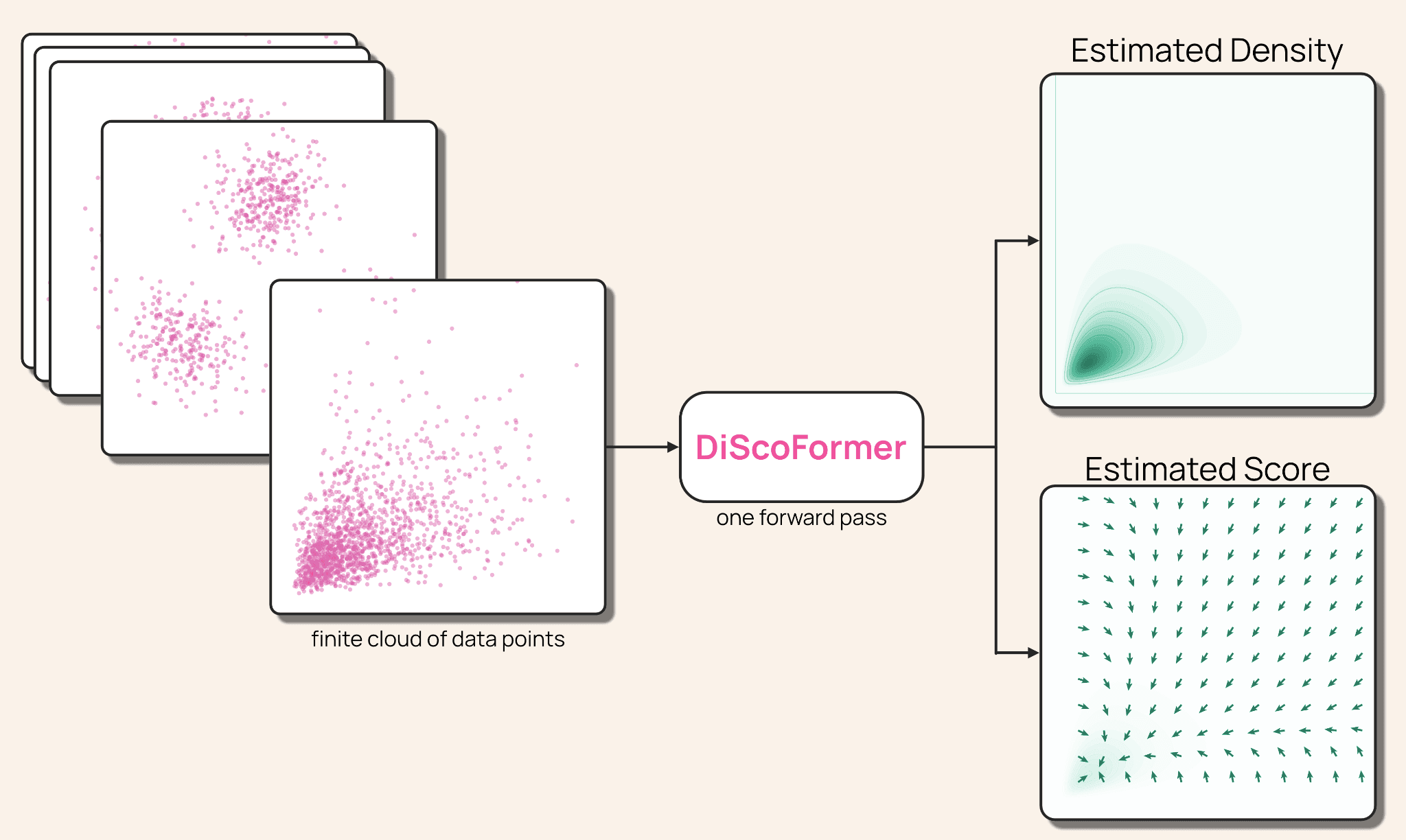
For decades, two paths have coexisted in the task of estimating a probability distribution from a handful of data points. Kernel density estimation (KDE) is universal, it works on any distribution with no training, but its accuracy collapses as the number of dimensions grows. Neural score-matching models stay sharp in high dimensions but must be retrained from scratch for each new distribution. Neither path has offered both generality and precision.
A team of researchers now proposes a third way: a transformer they call the DiScoFormer (Density and Score Transformer) that takes a set of data points and, in one forward pass, returns both the density and the score of the underlying distribution, without retraining. The method is detailed in a preprint that demonstrates strong performance on high-dimensional benchmarks, with implications for generative AI, Bayesian statistics, and scientific computing.
What density and score actually do
The density of a distribution is a smooth histogram: high where data points cluster, low where they are rare. The score is the gradient of the log-density, it points in the direction the density rises fastest. Move a point along the score and it heads toward a more probable region. This directional information is central to diffusion-based generative models such as Stable Diffusion and DALL-E: they start from random noise and repeatedly follow the score to produce realistic images. The same score drives Bayesian sampling and particle simulations used in plasma physics.
Extracting both quantities from a finite sample is the core difficulty. KDE places a kernel, a bump, at each data point and sums them to estimate density. It requires no training and generalizes to any distribution, but the cost scales poorly with dimensions, and its accuracy degrades rapidly. Neural score-matching models train a network to predict the score directly, staying accurate even in high dimensions, but each must learn the specific distribution and requires retraining when the data changes.
DiScoFormer’s architecture: attention as a generalized kernel
DiScoFormer maps an entire sample to the density and score of the distribution behind it using stacked transformer blocks with cross-attention. The key design insight is that a single cross-attention head computes weights that are nearly a Gaussian kernel over the data, a known mathematical fact the authors prove analytically. So one cross-attention block can already reproduce classical KDE’s density and score. But the transformer does not stop there: multiple heads and layers let DiScoFormer learn several kernel scales simultaneously and adapt them to the data’s local structure.
Score and density are mathematically linked, the score is the gradient of the log-density, and DiScoFormer exploits this by using a shared backbone with two output heads. This coupling gives a label-free consistency loss: at inference time, the prediction of the score head must match the gradient of the log-density head at every query point. The team uses this property to adapt to out-of-distribution inputs: hold the context fixed, take a few gradient steps on the consistency loss, and the model adjusts itself without any ground-truth density or score required.
Training on infinite mixtures
The training data consists entirely of Gaussian Mixture Models (GMMs). The authors give two reasons: GMMs are universal density approximators, with enough components they can match essentially any smooth distribution, and they have closed-form densities and scores, providing an exact target for every batch. The model sees a new GMM per batch, which effectively trains on an infinite supply of target distributions. This strategy removes the risk of overfitting to a fixed benchmark and equips the model to handle distributions far from what it saw during training.
High-dimensional advantage, classical-speed trade-off
The headline numbers come from 100-dimensional tests. Against the best hand-tuned KDE, DiScoFormer cuts score error by about 6.5x and density error by more than 37x. The gap widens as the sample size grows, KDE runs out of memory while DiScoFormer keeps improving. The model also generalizes to mixtures with more modes than it ever saw during training and to non-Gaussian shapes such as Laplace and Student-t distributions.
KDE retains an edge in speed, especially for small datasets. But the authors argue that for most applications where score estimation matters, generative modeling, Bayesian inference, scientific computing, being able to use a single pretrained model across many problems without retraining could outweigh the inference-time overhead.
One model for many fields
The most promising part of DiScoFormer is that score estimation is a shared dependency across several disciplines. Diffusion models need the score during sampling. Bayesian computation uses scores in Hamiltonian Monte Carlo and variational inference. Particle simulations in plasma physics and astrophysics rely on score-based correction steps. A pretrained, plug-in estimator that stays accurate in high dimensions and adapts to new distributions without retraining could reduce cost across all of them at once.
The researchers acknowledge that DiScoFormer is not yet a drop-in replacement for specialized neural score matching in all settings, each field has its own constraints on latency, memory, and desired accuracy. But the results suggest that a single transformer can bridge the gap between universal applicability and high-dimensional precision that has separated KDE and neural methods for years. Whether the approach becomes the default tool for distribution recovery will depend on its ability to scale to even higher dimensions and on whether the consistency-loss adaptation works reliably in real-world scientific workflows.