Robotics Research
New Framework Lets Robots Adapt to Novel Environments Without Retraining
A new framework called In-Context World Modeling (ICWM) allows robot policies to adapt to novel setups, like different camera angles or robot bodies, without retraining. By treating system identification as an in-context problem, ICWM uses task-agnostic interactions to infer world dynamics before task execution, outperforming standard VLA baselines in simulations and real-world tests.
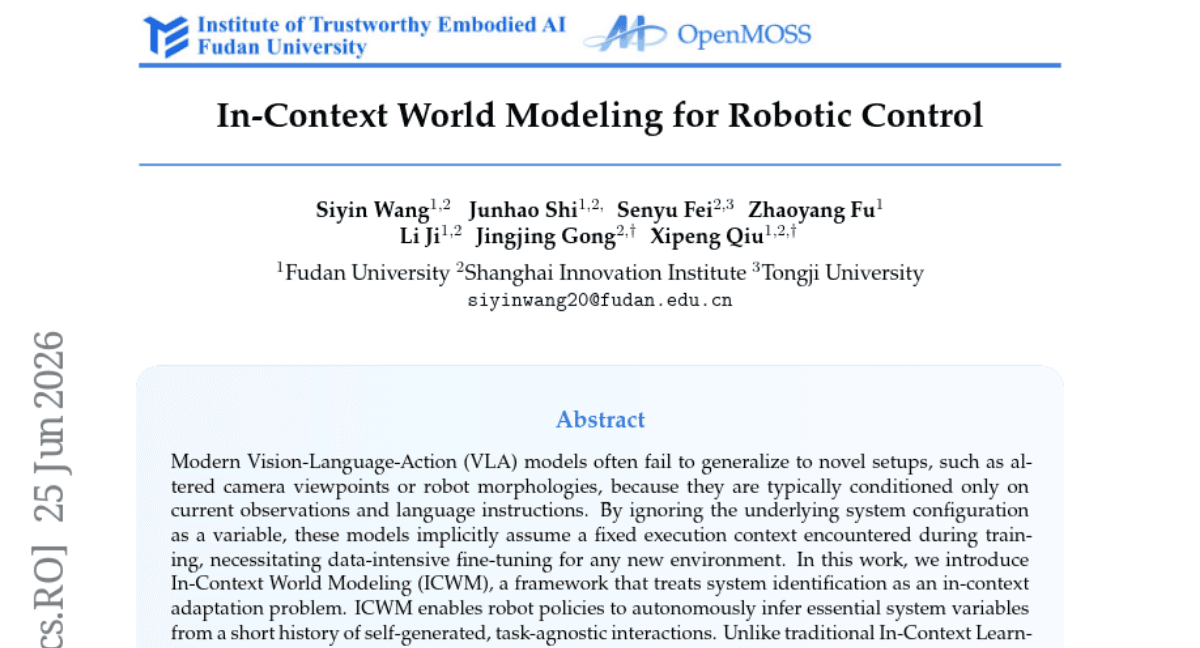
Modern Vision-Language-Action (VLA) models are central to robotic control, but they break down fast when the environment changes. A new paper from the OpenMOSS-Team, posted to arXiv on June 24, 2026, offers a fix: In-Context World Modeling (ICWM). The framework rethinks how robots adapt to shifts in camera angles, robot body types, or other system-specific variables, no costly fine-tuning or parameter updates required.
The problem with standard VLA models
Typical VLA models process visual input and a language instruction to generate motor commands. But they do not explicitly account for the system's underlying configuration, things like camera position, arm length, or gripper type. That means the model implicitly assumes it is operating in the exact same context it saw during training. When the robot lands in a new setup, performance tanks. Engineers then have to collect fresh data and retrain, a process the paper calls data-intensive and slow.
In-context adaptation, not fine-tuning
ICWM reframes system identification as an in-context adaptation problem. Instead of relying on static demonstrations that tell the model what task to do, like traditional In-Context Learning, ICWM uses a short history of self-generated, task-agnostic interactions to teach the model how the system works.
“Unlike traditional In-Context Learning that uses demonstrations to specify what task to perform, ICWM leverages the context window to understand how the system operates.”
The robot first executes a brief sequence of random or exploratory motions, jiggling an arm, rotating a joint, moving forward, completely independent of any task. These interactions are fed into the transformer-based policy as additional context before the actual task instruction. By processing that self-generated data, the model implicitly learns the world dynamics of the current system, from camera intrinsics and arm kinematics to the robot's inertial properties.
Results: outperforming baselines on novel viewpoints
The team tested ICWM in simulation and on real robots. In simulated environments, ICWM significantly outperformed standard VLA baselines when camera viewpoints changed. The improvement held across multiple random seeds and environment configurations, suggesting the method captures genuine system-level invariants rather than memorizing fixed patterns. Real-world experiments confirmed the trend: robots using ICWM succeeded at pick-and-place and navigation tasks under shifted camera positions where baseline models failed entirely.
The paper does not report exact success rates or statistical confidence intervals in the abstract. But it does emphasize that ICWM requires zero parameter updates after the short pre-task interaction phase. That alone could make it appealing for teams that want to deploy the same model across different robot hardware or adapt quickly to changing lab setups.
Broader context and future work
The work arrives as the robotics research community looks for ways to make large foundation models practical for real-world deployment. Most current approaches demand extensive domain-specific fine-tuning or rely on high-fidelity simulators that do not always transfer cleanly to physical hardware. ICWM offers a lighter alternative: a brief interaction phase and a context window big enough to hold both the system history and the task instruction.
The authors note that the framework currently assumes a fixed robot morphology during the interaction and task phases, if the robot's body changes mid-task, the model would need a new adaptation run. Extending ICWM to handle continuous or dynamic system identification remains an open direction.
Availability
The paper is on arXiv under the title In-Context World Modeling for Robotic Control (arXiv:2606.12345). Code and additional resources are expected from the OpenMOSS-Team's repositories, though no official link was provided at submission time.
The paper received 42 upvotes on Hugging Face at publication time, signaling strong community interest in this approach to in-context adaptation for robotics.