effective context, output ceilings, and the hidden tax of long windows
Your AI model says it can read 1 million tokens. It's lying. Here's the real math.
All four frontier LLMs advertise 1M+ token contexts, but effective recall, output limits, and real-world cost differ sharply. DeepSeek V4 Pro leads in output ceiling and cost, Gemini excels under 200K tokens, and Claude Opus wins on caching for interactive code review. This analysis breaks down the numbers from April 2026.
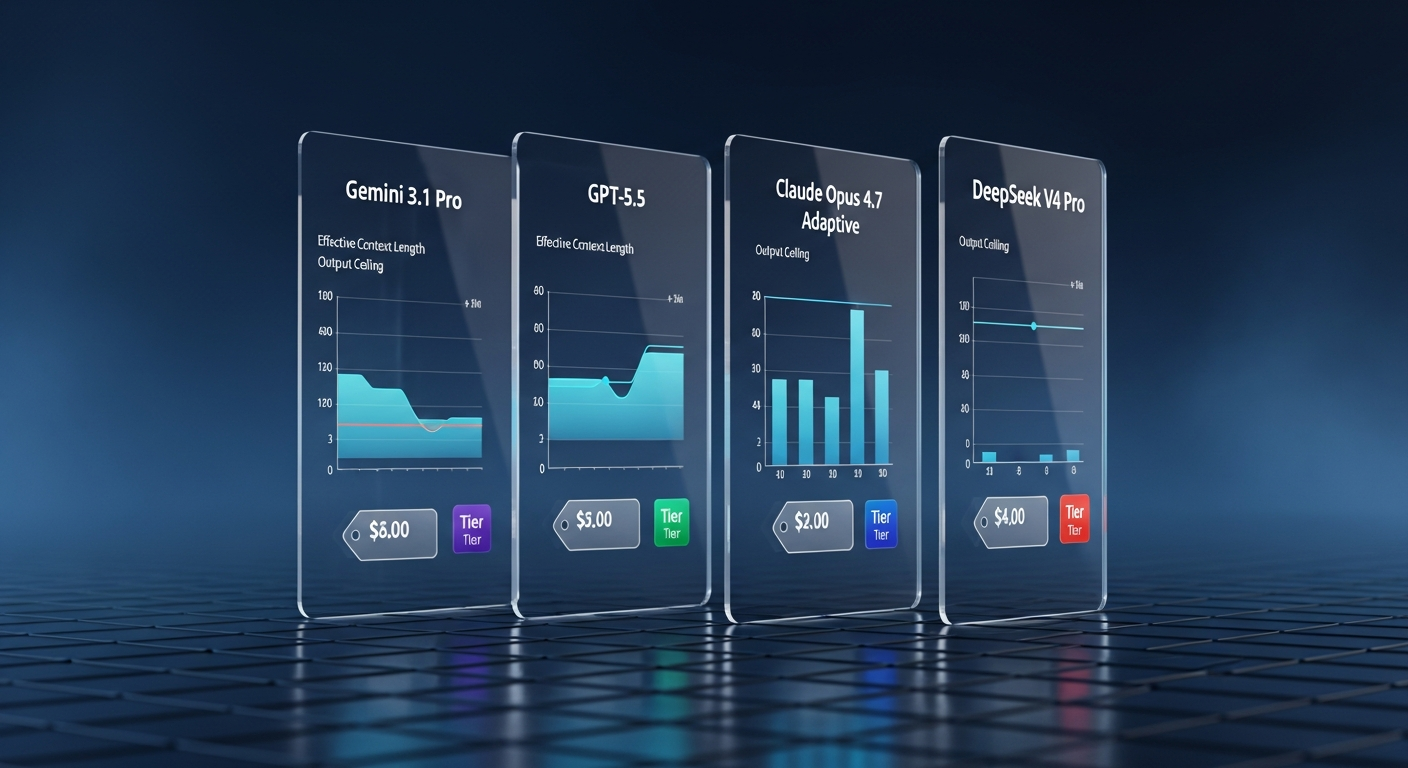
Four frontier LLMs now advertise 1M+ token context windows. The headline number is solved. What still differs sharply is how much of that window the model can actually use in practice, the effective context, how much it can write out in a single call (output ceiling), and what it costs to run at length. This post compares Gemini 3.1 Pro, GPT-5.5, Claude Opus 4.7 Adaptive, and DeepSeek V4 Pro across all three axes, using the live April 2026 numbers, not last quarter's.
TL;DR
- Gemini 3.1 Pro Strongest effective-context scores at 500K, 1M, but tiered pricing penalizes usage above 200K.
- GPT-5.5 Highest LongBench v2 and MRCRv2 scores; 128K output is fine for most generation but not all.
- Claude Opus 4.7 Adaptive Mid-context interactive sweet spot; 90% prompt caching is the real cost lever.
- DeepSeek V4 Pro The only model with a 384K output ceiling; cheapest input/output by a wide margin; cache hits drop input to $0.145/M.
The Headline Window
A 1M-token window is now table stakes across the frontier. All four flagships advertise effectively the same input ceiling, so the headline number stops being a differentiator. The interesting differences live in output capacity, pricing, and caching mechanics.
Output Ceiling: The 6x Gap
DeepSeek V4 Pro's 384K max output is 3, 6x larger than its peers. Gemini and Opus cap at 64K, GPT-5.5 at 128K. For workflows that generate long artifacts in a single call, full report drafts, large code translations, batch document rewrites, 384K is a structural advantage that no amount of prompt-side context fixes.
Pricing Tiers and Caching
Gemini 3.1 Pro charges $2.00/M up to 200K input tokens and $4.00/M above, the only model with a window-position-dependent input price. GPT-5.5 lists $5.00/M with prompt caching and Batch API at roughly 50% off. Claude Opus 4.7 Adaptive lists $5.00/M but offers up to 90% off on prompt-cache hits, landing effective input near $0.50/M. DeepSeek V4 Pro lists $1.74/M with cache hits at $0.145/M, about 92% off, the cheapest advertised cache rate in the frontier today.
Effective Context: Where Benchmarks Are Thin
The public eval surface has settled around four tests: NIAH (needle-in-a-haystack), LongBench v2 (multi-document QA), MRCRv2 (multi-round coreference), and RULER (synthetic probes). Third-party scores for the April 2026 checkpoints are sparse. The only published row in this set is GPT-5.5 at 87.5 on MRCRv2 (128, 256K), from BenchLM's research snapshot. Historical patterns: Gemini has led NIAH and effective-context evals through the 2.5 Pro generation; whether 3.1 Pro extends that lead against GPT-5.5 is an open question. Anthropic has taken a different path with prompt caching, biasing workflow design (load once, query many times) more than moving the effective-context score. DeepSeek V4 Pro's launch paper claims solid effective-context performance, but it is the newest model with the least third-party verification.
Why the Gap Exists
Attention dilutes as sequence length grows, positional encodings drift past the training distribution, and the "lost in the middle" effect means tokens at the start and end of context get more attention than tokens in the middle. Stack those three and you get the curve where a model nominally indexes 1M tokens but reasons reliably over far less. Practical rule: if you are filling more than 80% of an advertised window, run a smoke test on your data before committing.
Worked Examples
For document analysis under 200K tokens, Gemini 3.1 Pro is cheapest at $2/M. Above that, DeepSeek V4 Pro's $1.74/M dominates. For interactive code review with stable context, Opus 4.7 Adaptive's caching turns repeat queries into roughly $0.50/M operations. For output-heavy generation like a 50,000-word technical report (roughly 65K output tokens), DeepSeek V4 Pro and GPT-5.5 can do it in one call; Opus and Gemini require stitching. DeepSeek's $3.48/M output rate makes a 100K-token draft cost $0.348, compared to $3.00 on GPT-5.5 and roughly $3.38 on Opus.
Conclusion
Most production workloads fit under 200K tokens, chat, document Q&A, RAG queries. The 1M ceiling matters for the long tail, and pricing models punish you for using it without discernment. The honest answer is "use both": retrieval to narrow, long context to reason, and pick a model whose cost profile fits the dominant pattern. All four flagships are capable; none is best for everything.