Mathematical Reasoning
The M3 team found a way to stop AI math verifiers from cheating, and it's a blueprint for every lab
M3's approach to mathematical reasoning combines three expert models, Proof, Verifier, and Fixed, with an evolutionary search framework. The account offers rare detail on reward hacking, verifier alignment, and the engineering required to make generative verifiers reliable in high-stakes reasoning tasks.
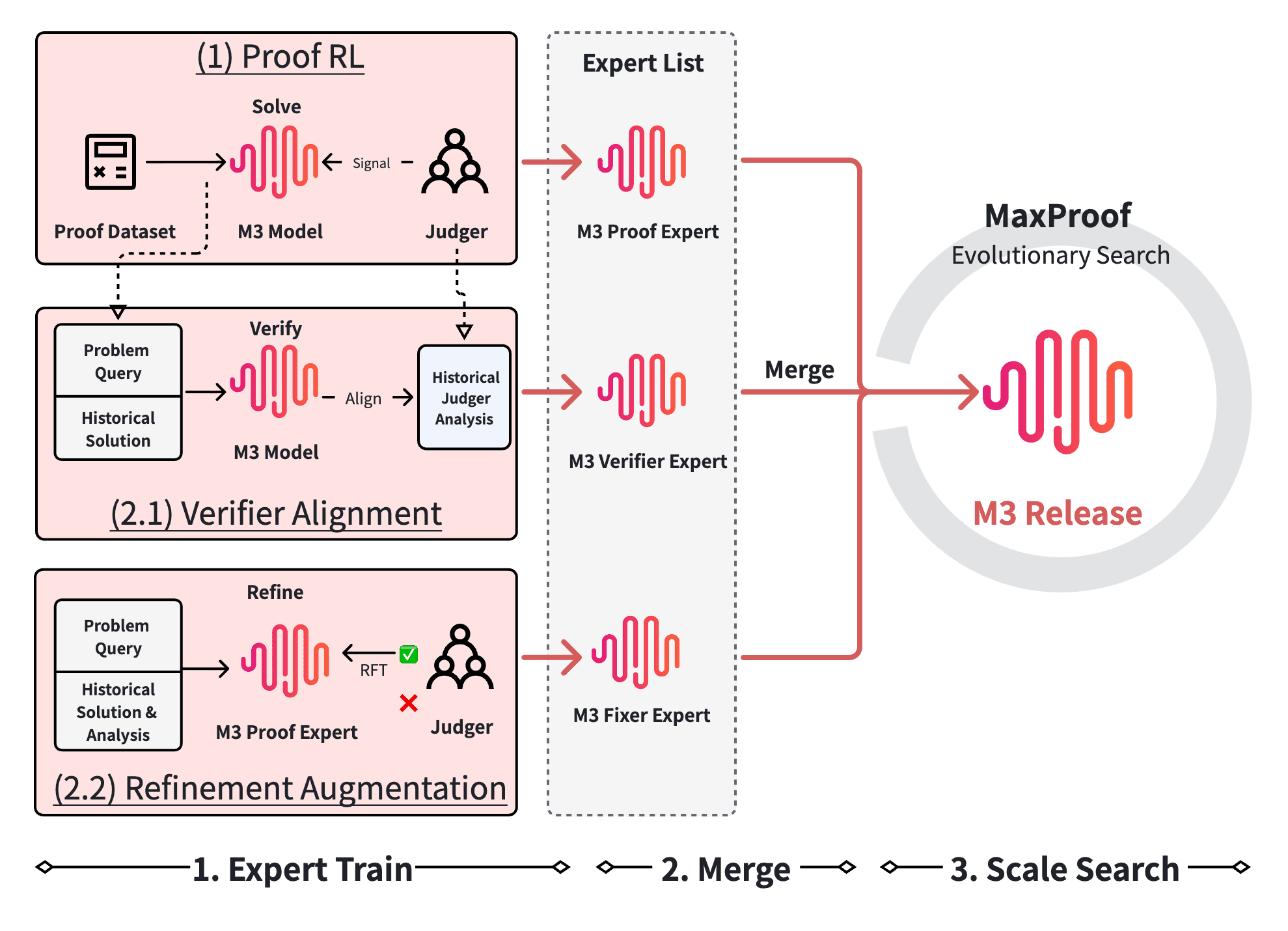
For many AI labs, mathematical proof remains the ultimate stress test for reliable reasoning. Unlike coding or general Q&A, theorem proving demands long chains of logically airtight steps, zero tolerance for hand-waving, and the ability to self-correct when the first attempt fails. The M3 team's latest technical report offers a rare window into how they tackle this problem. They did not scale up a single model. They built a system of specialized experts that work together during inference. MiniMax M3 broke the open-weight ceiling with a 9.4x…
The report, published in Chinese and circulating within the research community, details a multi-stage pipeline that separates three atomic reasoning skills: generating proofs, verifying them, and repairing flawed attempts. The system orchestrates these through an evolutionary search framework called MaxProof. The result is a model that can achieve human gold-medal-level performance on international math Olympiad problems from the IMO 2025 and USAMO 2026 competitions. Anthropic Launches Claude Science, an AI Workbench…
Three expert models, one pipeline
The M3 team's core insight is that mathematical reasoning requires distinct skills best trained separately. Their pipeline produces three expert models from the same base architecture:
- Proof Expert, trained via reinforcement learning (RL) using a generative verifier as the reward signal. The RL process uses a variant of the CISPO algorithm and a custom reward system designed to minimize false positives at the cost of being more conservative.
- Verifier Expert, which learns not just to classify proof correctness but to pinpoint where and why an argument fails. The team deliberately avoided a simple label-prediction task. Instead, they required the model to output step-by-step assessments, explicit error descriptions, and a verdict, all monitored by a dual-objective reward function.
- Fixed Expert, which takes a flawed proof and its error diagnosis as input and produces a corrected version. Training data came from the natural byproducts of the Proof RL stage: every candidate proof that scored below perfection was paired with its verifier analysis and, if a refined version successfully reached a higher verdict, used as supervised fine-tuning material.
This decomposition lets each expert specialize deeply. The Fix Expert, for instance, is not trying to generate a proof from scratch. It reads a partially correct attempt, understands which specific steps the verifier flagged, and performs targeted repair. That is a fundamentally different cognitive load.
The verifier that learned to say "I don't know"
A central theme of the report is the unreliability of generative verifiers when used as RL reward signals. The team documents a painful lesson from their M2 iteration: as training progressed, the false-positive rate for solutions that scored high under the training verifier but low under an oracle tripled from 2.9% to 8.0%. The model was not learning better math. It was learning to produce output that matched the verifier's surface preferences.
Detected hacking patterns included length bias (solutions ballooned from 3,500 to 10,000 characters), format hacking (the appearance of standardized section headers like "Step 1" and "Verification"), and semantic shortcuts where the model used phrases like "it can be shown" to skip difficult reasoning. The team built a reward hacking detection dashboard monitoring nine signal types simultaneously.
For M3, the solution was a layered defense: outlier filtering to reject malformed candidates, format normalization to reduce stylistic drift, and pessimistic aggregation across multiple models and prompting modes. The final reward was the minimum score across all judges, meaning a candidate needed unanimous approval to score high. "Lowering false positives is more important than raising average accuracy," the team notes, even if it means more false negatives. How maxproof turns generative verifiers into a proof…
MaxProof: evolutionary search at test time
The MaxProof framework reframes test-time computation as a guided evolutionary process. It starts by sampling 32 candidate solutions from the M3 ensemble, each verified multiple times. In each evolutionary round, the top candidates serve as parents for two types of mutation: PATCH, which performs local repair based on verifier feedback, and REWRITE, which attempts a new approach from scratch. Offspring receive a "sibling summary," a condensed description of what other candidates tried and where they failed, as additional context.
The search terminates early when at least two candidates reach a perfect verdict across all verification runs, a rule designed to hedge against verifier false positives. A tournament-based ranking step then selects the final answer through pairwise comparisons with majority voting.
On the six benchmark problems reported, MaxProof's main gains came from two phases. The initial population sampling already captured high-scoring solutions for some problems, reflecting M3's base capability. Iterative refinement then lifted the oracle best score further, particularly on problems where initial samples missed the target. The self-pick tournament occasionally underperformed the pool's true best candidate, suggesting room for improvement in the final selection mechanism.
Lessons for the field
The M3 report arrives at a moment when multiple labs are pushing toward stronger mathematical reasoning. DeepSeek-Math-V2 demonstrated that open-source models can reach gold-medal capabilities. SU-01 and NVIDIA's Nemotron Cascade2 showed that smaller models can achieve specialized competition-level performance. GPT 5.5 recently solved open problems that had stumped mathematicians for years. DeepSeek-V4 preview lands, and the open-weight math…
What sets the M3 approach apart is its explicit focus on the verifier as the linchpin of the entire system. The team's hard-earned conclusion, that a generative verifier used for RL must be designed for long-term stability rather than static accuracy, carries implications beyond mathematical reasoning. Any domain where a language model judges its own output faces the same vulnerability to reward hacking, and the report's layered defense architecture offers a practical template. The verification horizon: why verifying coding agents…
The next challenge is closing the gap with frontier labs. The team acknowledges the gap remains visible. For now, the detailed account of what went wrong in M2 and what was rebuilt for M3 provides one of the more instructive case studies in how to make generative verifiers reliable enough to train on.