Financial AI
The world's first AI-native credit card just rewired spending into compute
Moonshot AI issues an AI-native credit card with Agricultural Bank of China and American Express, linking membership tiers to card levels and offering token-based rewards. A look at how this embeds AI token economics into daily payments.
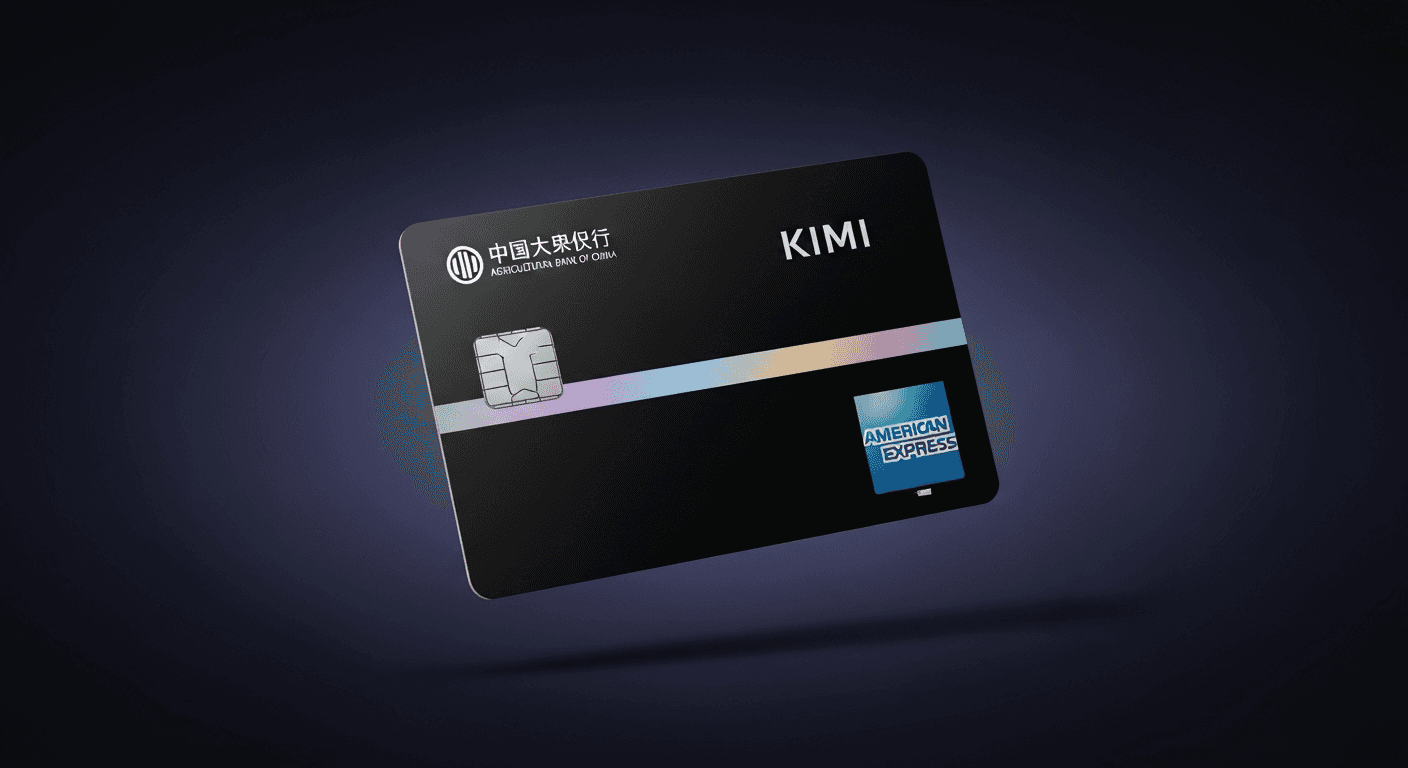
A card that trades in AI tokens, not just yuan
On July 10, 2025, Moonshot AI's Kimi became the first AI company to issue a credit card that treats spending as a gateway to compute. The card is a joint product with Agricultural Bank of China and American Express. It is not just a co-branded piece of plastic. It is a test of whether AI service distribution can be woven into the most mundane of financial instruments. MiniMax's new M2.5 coding model tops the benchmark at…
The core innovation is the direct linkage between AI membership levels and card tiers. The standard card grants Kimi Andante membership ($80 annual fee, waived on 10 yearly transactions), while the premium platinum version unlocks Kimi Allegretto tier ($122 annual fee, deductible with 200,000 reward points). Cardholders exchange consumption points for AI resources, Agent quota, Kimi Code time, and early model access, at a 1,000:1 ratio. Daily consumption points earn a 20% discount toward Kimi membership renewals.
The card took only three months from conception in April to public reservations in June, a compressed timeline typical of China's fast-moving fintech and AI ecosystems. By end of 2025, national card issuance had shrunk to 696 million units for three consecutive years. This product is a deliberate attempt to reverse that trend with AI as the hook. China's MiniMax just open-sourced a 1M-token model that…
Who benefits, and who is left out
For now, the card is squarely aimed at power users and developers. Premium platinum holders get peak-time AI priority scheduling, exclusive events, and prompt engineering courses, features that demand a baseline of technical comfort. The partnership with American Express gives Moonshot AI access to a global merchant network aligned with its international expansion: overseas paid users and API revenue both grew 400% year-over-year, and Kimi products now reach 200-plus countries and regions.
But the same token-for-points model that excites developers may confuse or alienate non-technical consumers. AI inference pricing is volatile. Tying card rewards to compute credits that can change value creates a layer of complexity most credit card users have never navigated. Industry analysts pointed out that the current model serves a niche, and converting consumption into AI resources at scale requires a leap in user education. Your AI model says it can read 1 million tokens. It's…
A broader trend: AI and banking spreads across China
Kimi's card is not an isolated experiment. Within the past month, at least five major Chinese banks have launched AI-power-linked credit cards. China Merchants Bank partnered with MiniMax in mid-June. Ping An Bank launched an AI Smart Computing Card with UnionPay and Tencent Cloud on June 30. Shanghai Pudong Development Bank partnered with UnionPay and Alibaba Cloud for a tech elite card offering up to 3 billion Qwen tokens in compute subsidies. MYbank upgraded its business card with Alibaba Cloud, offering up to 10 million tokens for small and micro operators. The AI safety framework nobody asked for might be the…
These products share a common logic: embed AI token economics into high-frequency payments. For AI companies, the model opens a second growth curve beyond subscriptions. For banks, it offers a differentiation tool in a shrinking market. But the convergence also creates new vulnerabilities, particularly around data privacy. A card that tracks spending to allocate compute must share transaction data between a bank, an AI provider, and an international payment network. That tripartite data handshake has no established compliance playbook in China or abroad. Atlas is dead. OpenAI's agent strategy just got…
The open question
The Kimi card is a structural experiment more than a consumer product play. It embeds AI access into a spending habit loop, converting everyday purchases into a pipeline that feeds the AI economy. If it scales, it could reshape how AI services are distributed, shifting from direct subscription billing to indirect, tokenized distribution through financial rails. If it fails, it will be because the gap between token economics and consumer finance proved too wide to bridge with a waiver and a set of reward points.
Moonshot AI has opened a door. Whether users walk through it depends on whether they see a credit card, or a compute account disguised as one. Y combinator's new ai stack gives students $25,000 in…