Artificial Intelligence
MiniMax's new M2.5 coding model tops the benchmark at 5% of the price
MiniMax's M2.5 model tops the Multi-SWE-Bench coding benchmark, beats mainstream models on workspace tasks, and costs a tenth to a twentieth of competitors. Open-source weights are on HuggingFace.
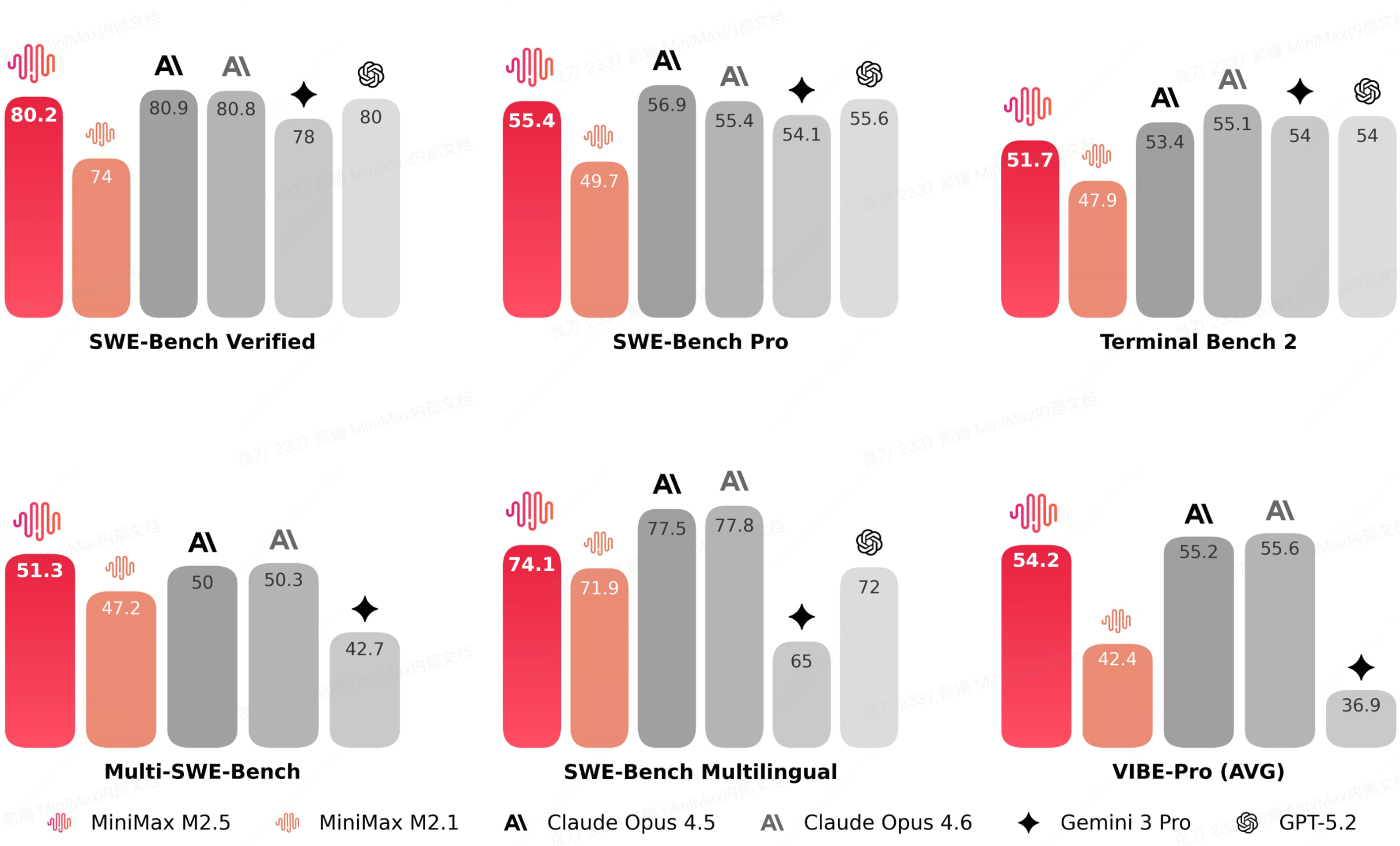
Chinese AI lab MiniMax just dropped M2.5, a large language model built from the ground up for coding and agentic tasks. The company calls this an 'Agent Universe' play, and the performance numbers back up the ambition: the model now leads the industry on the Multi-SWE-Bench multilingual programming benchmark.
Benchmark performance and coding prowess
M2.5 scores state-of-the-art on Multi-SWE-Bench, beating every previous model across multiple programming languages. MiniMax also reports that on agentic tasks the model shows higher decision maturity, needs fewer search rounds, and uses tokens more efficiently. That matters because a coding agent that wastes tokens is a coding agent that burns budget.
Workspace and productivity gains
In high-complexity workspace tasks, creating Word docs, building PowerPoint decks, doing Excel financial modeling, M2.5 averaged a 59% win rate against mainstream models. The company credits reinforcement learning optimizations that taught the model to decompose complex tasks and manage thinking tokens more effectively. That gives it an edge in both speed and cost for multi-step workflows.
Pricing and availability
M2.5 comes in two tiers: a standard version delivering 100 tokens per second and a high-speed tier at 50 TPS. Output pricing lands at one-tenth to one-twentieth what comparable models charge, according to MiniMax. The company claims an annual budget of about 10,000 yuan (roughly $1,400) can keep multiple agents running 24/7, enabling what it calls cost-unconstrained large-scale agent deployments. The model weights are open-source on HuggingFace.
Practical demonstrations
MiniMax showed a single-pass demo where M2.5 generated a personalized invitation code for a subscription service. The example highlighted the model's ability to handle structured data and produce customized output without multiple attempts.
The release positions M2.5 as a serious contender in the increasingly crowded coding-LLM space, especially for developers and enterprises that want high performance without the enterprise price tag.