Artificial Intelligence
The missing 'ums' and 'uhs' that finally make AI speech sound human
MiniMax's Speech 2.8 brings native filler words, breathing, and hesitation to AI voice synthesis, solving the 'too perfect' problem that has long made synthetic speech feel robotic. The model also delivers 10-second voice cloning and cross-language accuracy improvements.
The problem with perfect speech
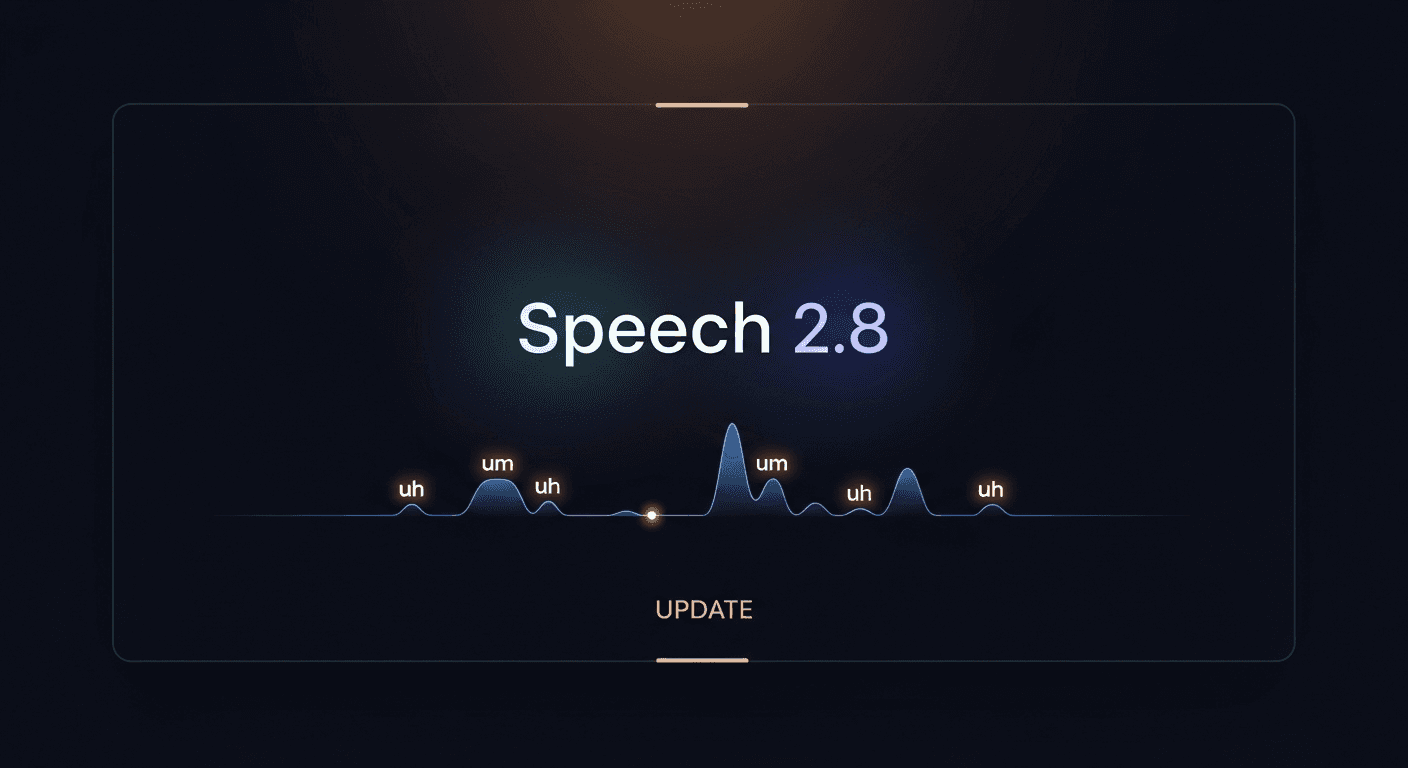
Synthetic voices have long suffered from a paradox: the cleaner the audio, the less human it sounds. Real people breathe, pause, stumble, and fill gaps with sounds like "um," "uh," and "ah." AI models have traditionally treated these as errors to suppress, producing speech that is pristine but emotionally flat.
MiniMax's Speech 2.8, announced today, takes the opposite approach. By modeling filler words natively instead of cleaning them out, the company aims to close the gap between machine output and human conversation.
Four pillars of the update
1. Native disfluency modeling
Speech 2.8 introduces natural language tags that preserve the rhythm and timing of spoken hesitations. In a demo audio, the model says: "Hey, it's me. How's it going? (Inhale) Yesterday's launch day really wore me out, you know? That non-stop feeling. (Normal breath) But I'm alive now, ready to start the next brick."
The script then reveals the speaker is the AI itself, a twist designed to highlight how convincingly the model mimics human breathing and conversational cadence.
This matters because studies in psycholinguistics show that pauses and fillers are not noise but signals. They indicate thought, emphasis, uncertainty, or connection. Removing them strips speech of its emotional texture.
2. Ten-second voice cloning
Voice cloning is not new, but MiniMax claims Speech 2.8 captures not just timbre but speaking style, including characteristic breaths, vocal fry, and pacing. The company says the system can replicate a speaker's "soul," citing examples where it reproduces low-frequency chest resonance, nasal traits, and even the subtle sarcasm in how a speaker draws out certain syllables.
The barrier for cloning is set at 10 seconds of reference audio, a low enough threshold to make the feature practical for real-time applications.
3. Studio-grade audio
An upgraded audio pipeline removes background noise and digital artifacts. The result, according to MiniMax, is "as if the speaker is sitting in front of you recording in a studio."
4. Cross-language accuracy
Speech 2.8 addresses a common issue in multilingual synthesis: accent bleed. In a Chinese-to-Japanese example, the model switches between Mandarin and Japanese mid-sentence without phonetic misalignment or unnatural pitch shifts. MiniMax says more language pairs will be optimized over time.
Market context
The voice AI space has become increasingly crowded. ElevenLabs leads in realism and speed, while OpenAI's Advanced Voice Mode powers ChatGPT's conversational interface. Open-source models like Bark and XTTS offer flexibility but lag in consistency.
MiniMax's bet on native disfluency is a distinct strategy. Most competitors treat filler sounds as noise to be minimized. Speech 2.8 explicitly embraces them as a design feature. If executed at scale, this could give MiniMax an edge in applications where emotional authenticity matters, such as customer service, audiobooks, virtual assistants, and interactive storytelling.
However, the same technology raises familiar ethical questions. High-fidelity voice cloning with disfluency may make synthetic voices indistinguishable from real ones, increasing risks of impersonation and fraud. MiniMax does not detail anti-abuse measures in this announcement.
Availability
Speech 2.8 is available now via the MiniMax open platform and the MiniMax Audio API. The company says it supports over 40 languages from a single voice profile, with more cross-language optimizations to follow.