AI Agents
Parallel agents aren't about speed. They're about coordination.
Parallel agents split complex tasks across concurrent workers, each with isolated state and defined scope. The real challenge isn't speed, it's coordination.
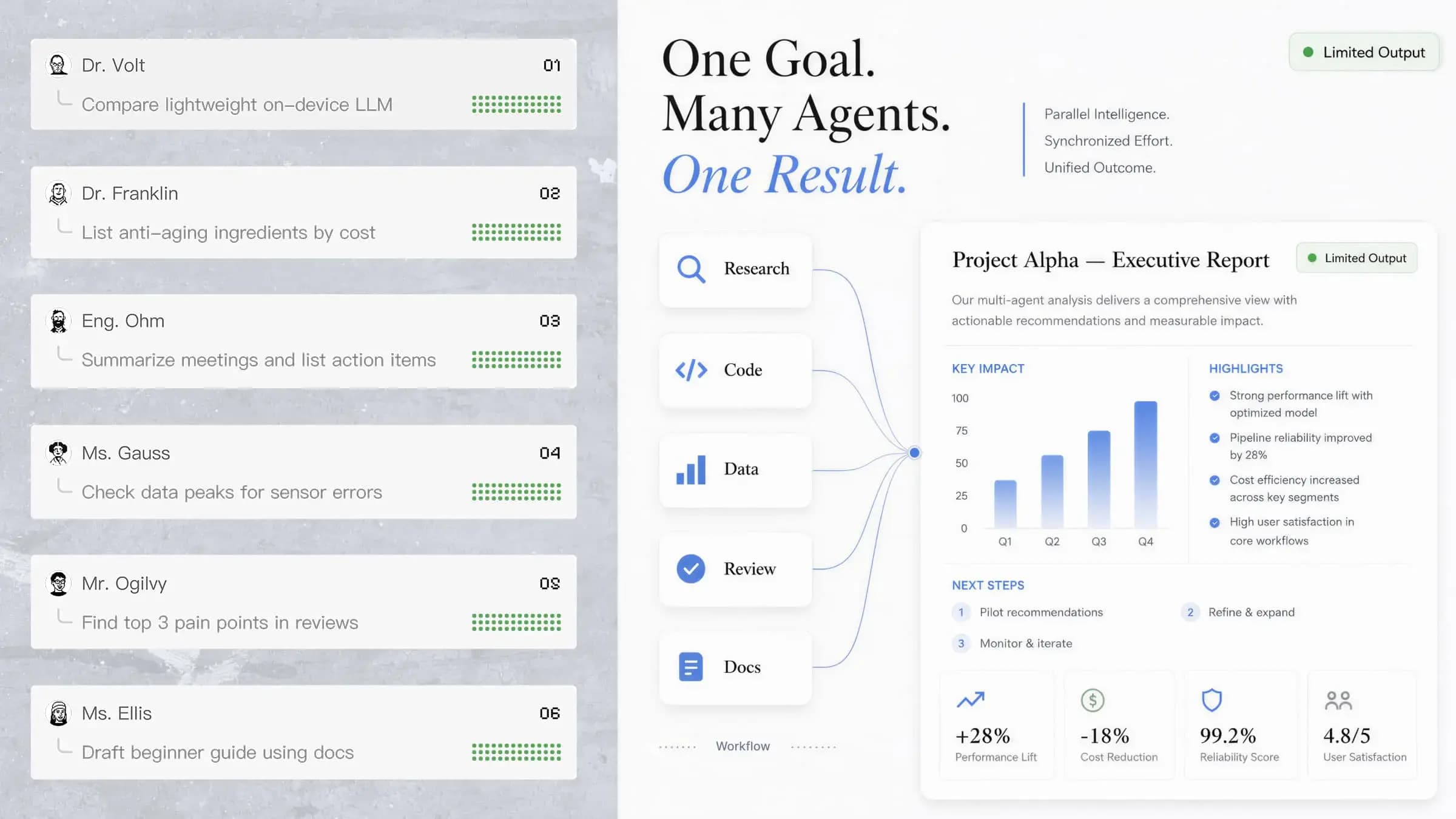
Parallel agent systems have left the research lab and started showing up in production workflows. The pitch is simple: instead of a single AI agent chewing through a complex task from end to end, break the work into independent subtasks and assign each to a dedicated agent running at the same time. Faster execution, better specialization, less context overload. But the gap between a whiteboard diagram and a system that actually works in production is wide, and it is filled with architectural decisions most guides skip over.
The source material for this article, a guide to parallel agent systems built around Kimi Agent Swarm, lays out the textbook explanation. The real story is the tension between what parallelism promises and what coordination costs. The companies that win the next phase of AI orchestration will be the ones that manage this tension, not the ones that chase raw concurrency numbers.
The architecture behind the hype
A parallel agent workflow needs five parts: task decomposition, parallel execution with state isolation, result collection, and synthesis or review. The source material lists them accurately, but understanding why each matters means looking at the failure modes they prevent.
State isolation is the one nobody talks about enough. When multiple agents share a single context window, one agent's half-formed assumptions or speculative suggestions can bleed into another agent's work. The fix is hard isolation: each agent gets its own sandbox, its own private memory, its own tool permissions. In Kimi Agent Swarm, coding agents each operate in a separate branch or worktree to stop overwrites. In research tasks, agents keep separate note collections so evidence does not mix prematurely.
But isolation creates its own problem. When the orchestrator gets conflicting outputs, is it looking at genuine disagreement or parallel paths that should have converged? The answer has to come from the synthesis stage, which needs a real conflict resolution protocol. The source material notes that "more agents can produce more coverage, but they can also produce more disagreement." It does not emphasize enough that without a clear rule for trusting one result over another, source quality scores, test results, business constraints, the system can turn into expensive indecision.
Patterns that work, and one that doesn't
The source identifies four common patterns: fan-out/fan-in, specialist parallelism, competing solutions, and parallel coding agents. Each has a natural use case, but one carries hidden risk that the guide understates.
Fan-out/fan-in is the safest. Five agents research five competitors. Each returns a structured report. A synthesis agent merges them. The subtasks are genuinely independent and the merging is straightforward. This pattern works well for research, market scans, and broad discovery.
Specialist parallelism assigns different roles to different agents. A research agent collects sources. An analysis agent extracts patterns. A writing agent drafts. A QA agent verifies facts. The problem is that each stage depends on the quality of the one before it. If the research agent misses key sources, everyone downstream builds on an incomplete foundation. Production systems need feedback loops: the writing agent should be able to flag gaps back to research, and the QA agent should have tools to request more collection. It is not true parallelism, more of a pipeline with some concurrent stages, but it is often more useful than isolated parallel agents.
The competing-solutions pattern is the most intriguing and the most likely to be misapplied. Multiple agents solve the same problem independently, and the system picks the best answer. Three agents proposing different database schemas can reveal hidden assumptions and lead to a stronger design. But this only works when the evaluation criteria are objective and the orchestrator can compare apples to apples. In creative tasks like naming or strategy, where success is subjective, competing solutions produce paralysis instead of insight.
Parallel coding agents are the most ambitious pattern and the one with the steepest failure curve. The source material rightly warns about merge conflicts, but the real issue is semantic integration. Two agents can independently implement compatible code that breaks when integrated, one optimizes a function for speed, another optimizes a different function for memory, and together they blow the resource budget. Without integration tests running after every parallel wave, parallel coding is gambling.
Kimi Agent Swarm: dependency-aware parallelism in practice
The source's extended example of Kimi Agent Swarm building an enterprise dashboard is useful because it highlights a pattern the generic guide misses: dependency-aware parallelism. The orchestrator builds a dependency graph, figures out which tasks can run simultaneously and which must wait, and runs stage gates between waves. In the first wave, the database designer, API architect, and frontend scaffold agent run in parallel. After they finish, the orchestrator checks that field names, data types, and route mappings are consistent before the second wave starts.
This two-wave approach is more realistic than pure fan-out. Real software engineering has irreversible dependencies: the API contract has to be stable before the visualization agent builds charts against it. Kimi Agent Swarm's ability to coordinate up to 300 sub-agents is impressive, but the real differentiator may be the orchestration logic that decides when to parallelize and when to synchronize.
The source claims the system supports over 4,000 tool calls per task. That number raises questions about cost and latency that the guide does not address. Parallel execution cuts wall-clock time but can increase total compute because multiple agents are running at once. For a 300-agent task, compute cost could be substantial, and the orchestrator's overhead, planning, monitoring, conflict resolution, adds to the total. The question for practitioners is whether the speedup is worth the resource multiplier.
When parallel agents make sense, and when they don't
The source offers a reasonable caveat: "For simple tasks, parallel agents may add unnecessary complexity." Correct, but mild. The decision to use parallel agents requires a cost-benefit analysis that accounts for error rate, not just speed. Parallel systems introduce failure modes, state inconsistency, integration defects, wasted compute on dead branches, that sequential systems avoid.
Parallel agents are most valuable when:
- The task has many genuinely independent subtasks. Research across multiple sources, batch processing of many files, comparing many documents.
- The task benefits from role specialization. A single agent asked to be researcher, writer, and reviewer will produce lower quality than three specialists.
- The cost of error is low enough that parallel redundancy is affordable. Competing solutions are wasteful if each one uses expensive compute.
- The synthesis stage is straightforward. If merging parallel outputs is harder than doing the work sequentially, parallelism is a net negative.
Parallel agents are a poor fit for:
- Tightly coupled tasks where each step depends on the previous one. Adding parallelism to a sequential dependency chain only adds overhead.
- Simple tasks a single agent can handle reliably. The orchestration overhead for a two-agent system on a job solvable in one prompt is wasteful.
- High-stakes decisions where conflicting outputs cannot be resolved automatically. If a human has to review every parallel branch anyway, the speed advantage disappears.
The road ahead
The source material positions Kimi Agent Swarm as a practical example of parallel agents in production. The broader trend is real: as LLMs get more capable, the bottleneck shifts from model intelligence to system architecture. Parallel agent systems are one of the most promising ways to scale AI beyond single-turn, single-agent interactions.
But the next generation of these systems will need to handle the coordination challenge more directly. Current approaches rely heavily on the orchestrator's ability to decompose tasks correctly and handle conflicts gracefully. When the orchestrator itself is an LLM, that creates a meta-coordination problem: the orchestrator can make mistakes that propagate across all parallel branches. Researchers are already looking at hierarchical orchestration, where multiple orchestrators supervise different groups of agents, and adaptive decomposition, where the system learns task structures from past runs.
The message for engineers evaluating parallel agent systems is simple: use the architecture for the right problems, but go in with your eyes open about the coordination overhead. The next battleground in AI orchestration will not be about raw parallelism. It will be about how well the system manages the complexity parallelism creates.