Coding Agents
Cognition's new coding agent scores near frontier results for pocket change
Cognition's SWE-1.7 coding model narrows the gap to frontier systems at a fraction of the cost, scoring 42.3% on FrontierCode and running at 1,000 tok/s. The model was trained on an improved reinforcement learning pipeline using Kimi K2.7 as the base.
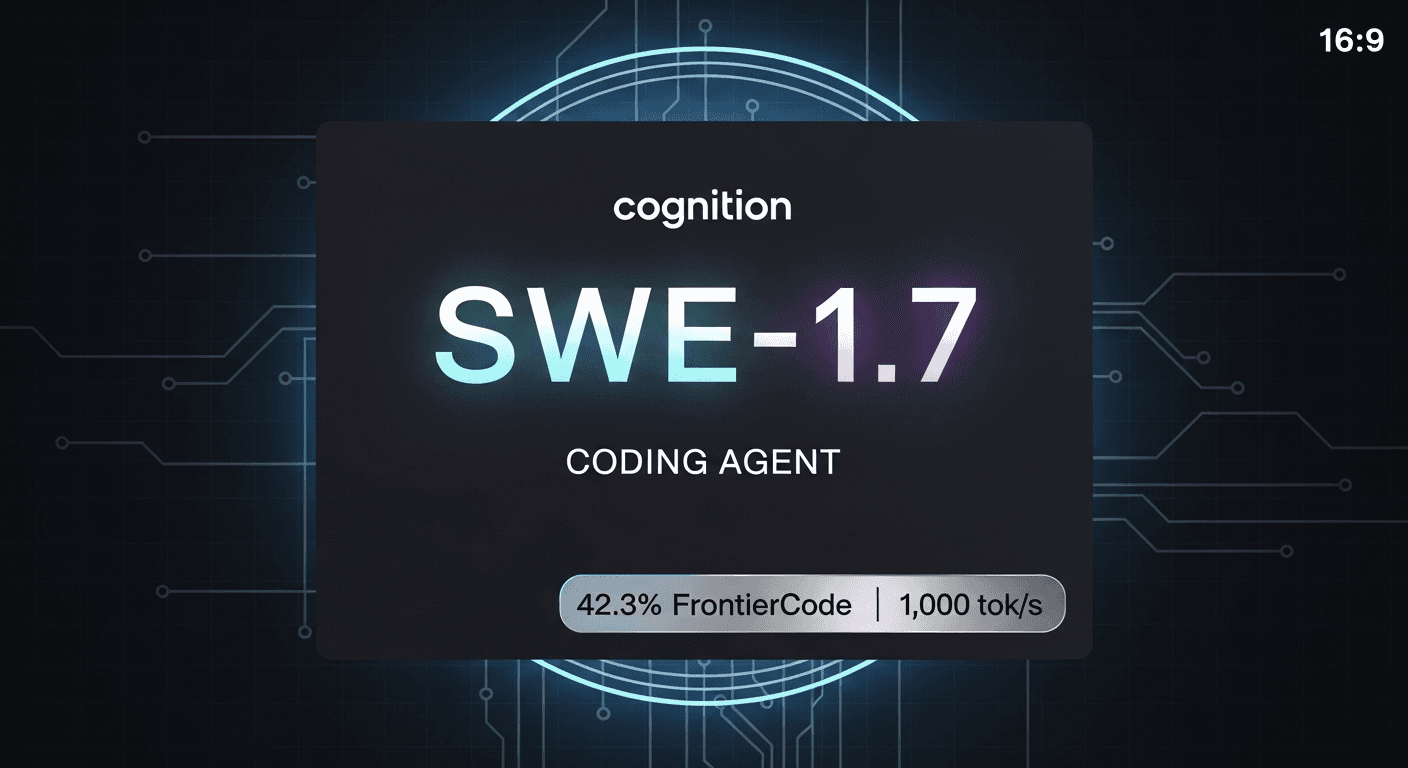
Cognition, the startup behind Devin, released SWE-1.7 today. The company says the model is its best yet and that it undercuts the idea that RL has hit a ceiling. Running at 1,000 tokens per second, it scores 42.3% on Cognition's internal FrontierCode suite, a few points behind the best frontier models, per the company.
Reinforcement learning gains continue
The cost is the headline figure: each task on the benchmark costs $1.97, a sliver of what the frontier players charge. Cognition says it got there by refining its RL pipeline on a Kimi K2.7 base, and that the improvement suggests RL still has room to run.
"RL is not hitting its limit: after refining our recipe, we keep seeing gains as we scale," the company wrote on X.
FrontierCode benchmark
FrontierCode is Cognition's own test: it checks whether a model produces code a developer would actually merge. That proxy for real-world usefulness goes beyond academic leaderboard chasing. SWE-1.7's 42.3% is a meaningful step on the cost-performance curve.
The model is live on Cognition's platform, aimed at developers and teams that want fast, cheap code generation without losing accuracy.
SWE-1.7 enters a field already packed with coding agents and specialized models from Anthropic's Claude and OpenAI's GPT-4o. Cognition's bet is that its training recipe and pipeline efficiency give it an edge, not the raw parameter count.