AI Infrastructure
Nvidia's 55-billion-token trick just rewrote the math on agentic AI costs
Nemotron 3 Ultra, Nvidia's sparse 550B model with 55B active parameters, promises to cut inference costs by up to 30% versus peer open models while keeping frontier reasoning. With a 1M-token context window and native NVFP4 quantization, it targets the cost of multi-step agentic workflows.
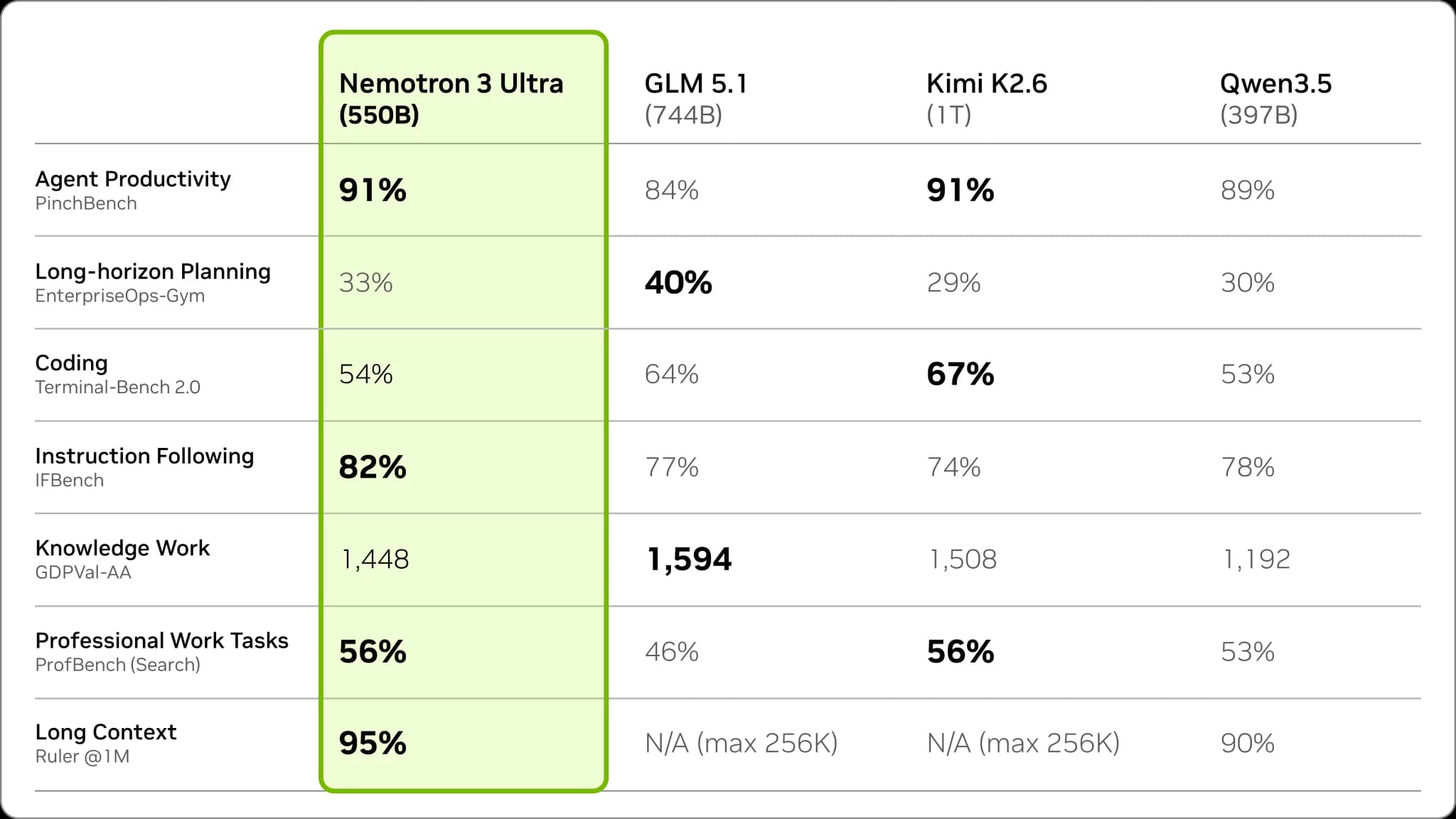
Nvidia is betting that the future of AI infrastructure will be measured by the total cost of a multi-step reasoning chain, not by single-shot latency. The company released Nemotron 3 Ultra on Ollama Cloud today. On paper, the model looks unremarkable, with 550 billion parameters. Then you hit the fine print: only 55 billion activate per token. The 90% sparsity ratio is the product, not the parameter count.
The broader theme here is that the industry is shifting from one-shot answers to long-running agent pipelines, and the billing model needs to catch up. For more on why the hardest metric for coding agents to fake is human hours, the same logic applies to compute: you want to pay for work done, not for parameter count parked in memory.
Nemotron 3 Ultra belongs to a new wave of models built for agentic workflows: orchestration tasks, coding agents, deep research, and enterprise pipelines that run across hundreds of tool-calling steps. The model supports a 1-million-token context window, large enough to hold an entire codebase, a long tool history, or a multi-chapter research trail without losing accuracy.
"The real cost in agentic AI isn't the single forward pass," said an independent AI infrastructure analyst. "It's the aggregate cost of maintaining coherent reasoning across a long chain of tool calls. A model that stays accurate from step 1 to step 300 changes the economics of the whole deployment."
This echoes findings from RecursiveMAS, where agent-to-agent thinking without text exchange ran 2.4x faster: both point to the same bottleneck, the communication and reasoning overhead in multi-step chains is where the real cost lives.
The architectural lever is NVFP4, Nvidia's 4-bit floating point format, which shrinks memory footprint and speeds up inference. Combined with a routing mechanism that activates only one-tenth of the total parameters per token, Nemotron 3 Ultra claims to deliver leading throughput on agentic benchmarks while cutting inference costs by up to 30% relative to comparably capable open models.
Nvidia's competitive positioning is clear. Benchmark graphs released with the model put it in the upper-right quadrant of accuracy versus throughput, ahead of existing open alternatives for agent productivity, code generation, and instruction following. The company emphasizes that the model's tuning, not its pretraining, is what sets it apart. Nemotron 3 Ultra was fine-tuned specifically for orchestration, reinforcement learning feedback loops, and long-context retrieval.
Nvidia has also published a data atlas showing why synthetic data matters more than model weights, which reinforces that the fine-tuning recipe, not just the architecture, is the moat they are building.
Availability and tool integrations
The model is available today through Ollama Cloud. Users invoke it with a single command, ollama run nemotron-3-ultra:cloud, and can bridge it into existing agent frameworks like Claude Code, Hermes Agent, and OpenClaw, all of which support it at launch. Nvidia promises additional integrations in the coming weeks.
The Ollama distribution channel is notable given Ollama's controversial 85%-of-Fortune-500 claim: whether that stat holds up or not, Nemotron 3 Ultra landing on their cloud gives it immediate enterprise distribution.
The hook for developers is straightforward: swap in a single model to replace a more expensive counterpart and, if the benchmarks hold, get comparable or better accuracy at reduced runtime cost. The 1-million-token context may appeal especially to teams building agents that need to maintain memory of prior actions across distributed API calls or database schemas.
Implications for the agentic AI ecosystem
Nemotron 3 Ultra arrives as the industry wrestles with a fundamental tension. Agentic architectures demand more tokens per task than traditional Q&A, which pushes up cloud bills. Most optimization efforts have focused on model distillation or prompt compression. Nvidia is instead offering a sparse, natively quantized model that claims to change the per-task cost curve from the architecture side.
"If Nvidia can deliver on the 30% cost savings without sacrificing accuracy on real agentic tasks, it creates a new floor for what's economical," said a startup founder working on enterprise AI, who asked not to be named due to ongoing negotiations with cloud providers. "Right now, a customer chat that needs five tool calls over a 50,000-token context is way more expensive than a simple answer. That gap is the biggest blocker to adoption."
The model also tests how far the industry has come in accepting sparsity as a production strategy. Early sparse models suffered from unpredictable compute requirements, but Nvidia claims Nemotron 3 Ultra's routing is deterministic per token, making it suitable for latency-sensitive workloads.
Competitive landscape
The model directly competes with dense models of similar capability from Anthropic, OpenAI, and Meta, though Meta has also explored mixture-of-experts architectures with Llama 4 variants. Nvidia's edge is its own hardware. NVFP4 is a format that the company designs its GPUs to run natively, potentially meaning that Nemotron 3 Ultra benefits from firmware and silicon-level optimizations that competitors cannot replicate.
Early adopters will test the model on real multi-step tasks like coding, data extraction, and tool orchestration that stress both long-context retention and instruction-following. The official benchmarks show Nemotron 3 Ultra leading among open models on those axes, but independent validation will clarify whether the 30% cost savings materialize under production load.
If the cost math holds, the model could give enterprises the same kind of ROI rethink that Sonnet 4.6 gave to Opus buyers: a cheaper alternative that does not ask you to give up quality on the tasks that matter most.
For now, Nvidia has added a credible option to the agentic AI toolkit: one that foregrounds the total cost of a reasoning chain rather than the price tag of a single query.