Artificial Intelligence
MiniMax M3 broke the open-weight ceiling with a 9.4x CUDA speedup and zero human help
MiniMax M3 delivers a 9.4x CUDA kernel speedup, beats Opus 4.7 on BrowseComp, and autonomously replicated an ICLR paper. All in an open-weight package.
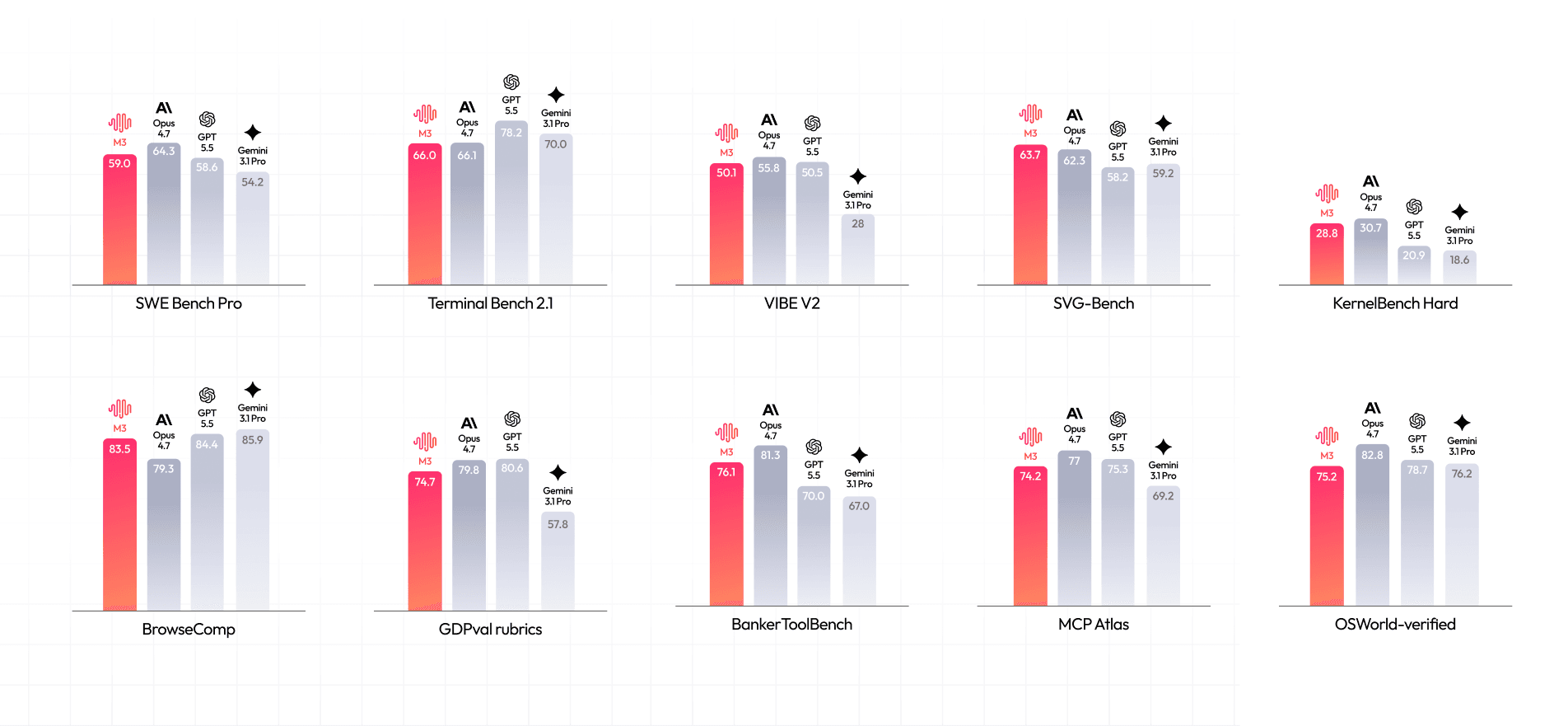
Chinese AI startup MiniMax has released M3, a new flagship foundation model that the company claims is the first open-weight model to simultaneously deliver frontier coding performance, a million-token context window, and native multimodal understanding. The model is built on a proprietary MiniMax Sparse Attention (MSA) architecture and is available via API with automatic caching. MiniMax's product blitz: new models for code, music,…
Benchmark highlights
MiniMax reports that M3 achieves industry-leading results across several coding and agentic benchmarks. On the BrowseComp agentic evaluation, M3 scored 83.5, surpassing OpenAI's Opus 4.7, which scored 79.3. The model also demonstrated strong performance on software engineering, terminal execution, and tool-use tasks. MiniMax's new M2.5 coding model tops the benchmark at…
In an autonomous paper replication experiment, MiniMax tasked M3 with reproducing the ICLR 2025 Outstanding Paper 'Learning Dynamics of LLM Finetuning.' Over nearly 12 hours, M3 independently generated 18 commits and 23 experimental figures, successfully running the core experiments without human guidance. How Local LLMs Like Gemma and Qwen Are Taming Open…
CUDA kernel optimization
M3 also demonstrated its autonomous engineering abilities by optimizing a FP8 matrix multiplication kernel on NVIDIA's Hopper architecture. Starting from only a task description and a non-functional Triton skeleton, M3 completed 147 benchmark submissions and 1,959 tool calls over roughly 24 hours, improving hardware utilization from 7.6% to 71.3%, a 9.4× speedup with zero human intervention. The verification horizon: why verifying coding agents…
PostTrainBench: M3 trains models
MiniMax also ran a test called PostTrainBench, where M3 was given four pre-trained base models and asked to autonomously complete the full post-training pipeline, data synthesis, training, evaluation, and iteration, within 12 hours. M3 scored 37.1, ranking third behind Opus 4.7 (42.4) and GPT-5.5 (39.3), but significantly ahead of all other tested models. OPID gives language agents a reward signal dense enough…
Architecture and availability
M3 is built on the self-developed MiniMax Sparse Attention architecture, which supports an API context window of up to 1 million tokens, with a guaranteed usable length of at least 512K tokens. The model is natively multimodal, with text and visual semantic spaces aligned from the start of training, rather than through post-hoc patching. Why vision-language papers are flooding Hugging Face…
MiniMax positions M3 as the first model to bring a complete frontier capability set, coding, long-context agents, and native multimodality, into the open-weight ecosystem. The model is accessible via API, which includes automatic caching at no extra configuration. AI as an extension of human intelligence, not a replacement