Reinforcement Learning Research
OPID gives language agents a reward signal dense enough to ditch external memory
OPID extracts hierarchical skill supervision from completed on-policy trajectories, providing dense token-level guidance for language agent training without external memory. Experiments on ALFWorld, WebShop, and Search-based QA show improved performance and sample efficiency over outcome-only RL and existing skill-distillation methods.
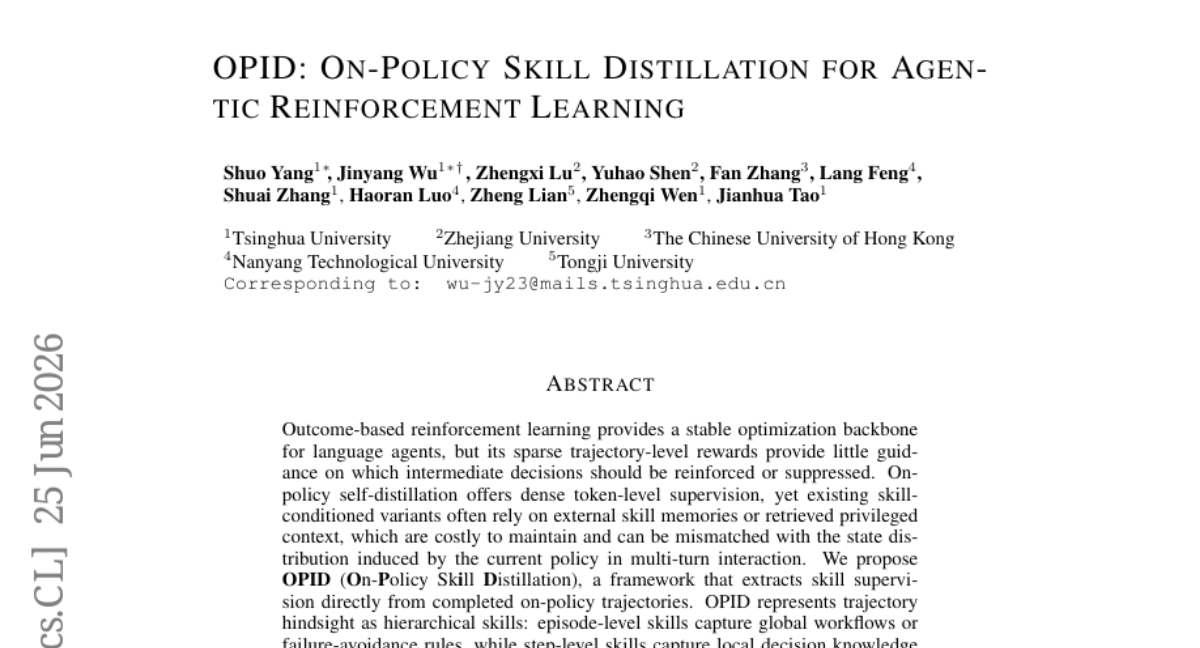
A team of researchers has introduced OPID (On-Policy Skill Distillation), a framework that tackles a persistent problem in outcome-based reinforcement learning for language agents: the sparsity of trajectory-level rewards. By pulling dense, token-level supervision straight from completed on-policy trajectories, it offers intermediate decision guidance without the overhead of external skill memories or retrieved privileged context. Those alternatives, the researchers note, are costly to maintain and often fall out of sync with the state distribution during multi-turn interactions.
The paper, posted to arXiv on June 25, 2026, under Computation and Language, frames trajectory hindsight as hierarchical skills. Episode-level skills capture global workflows or failure-avoidance rules, while step-level skills capture local decision knowledge at critical timesteps. A critical-first routing mechanism decides when to apply step-level guidance, falling back to episode-level skills as a default.
Core Mechanism
The architecture preserves reinforcement learning as the primary training objective but layers in dense, distribution-matched hindsight supervision. The selected skill gets injected into the interaction history, letting the old policy re-score the same sampled response under both original and skill-augmented contexts. The resulting log-probability shift produces a token-level self-distillation advantage, which is then combined with the outcome advantage for policy optimization.
This sidesteps the drawbacks of existing skill-conditioned variants. Those often demand building and updating external skill memories, a computationally heavy process that can generate skills misaligned with the current policy's state distribution, especially in multi-turn agentic tasks. OPID instead extracts skills from on-policy data, keeping them relevant and cutting overhead.
Benchmark Performance
The team ran OPID across three benchmarks: ALFWorld (embodied agent tasks), WebShop (online shopping), and Search-based QA (information retrieval). In every domain, the framework outperformed outcome-only reinforcement learning and existing skill-distillation baselines, including methods that rely on external skill repositories.
Key results show gains in both final performance and sample efficiency. The work also points to enhanced robustness, suggesting that hierarchical hindsight supervision helps agents generalize better across episodes. The code is available on GitHub at https://github.com/jinyangwu/OPID/tree/main.
Implications for Agentic AI
The release arrives as the AI research community zeroes in on training language agents capable of multi-turn interactions with their environments. Reinforcement learning offers a stable optimization backbone, but the scarcity of reward signals, often just a single outcome reward per trajectory, has long been a bottleneck.
By extracting dense supervision from on-policy trajectories without external memory, OPID provides a practical, scalable solution. The approach is a natural fit for agentic tasks where intermediate decisions make or break the final outcome, think web navigation, tool use, or multi-step reasoning.
The researchers plan to extend OPID to more complex environments, and they're eyeing ways to learn the hierarchical skill representation in an unsupervised manner for broader applicability.