AI Inference Acceleration
JetSpec Breaks the Scaling Ceiling of Speculative Decoding with Parallel Tree Drafting
JetSpec trains a causal parallel draft head over fused hidden states from the target model, producing candidate trees aligned with autoregressive factorization. It consistently outperforms baselines across dense and MoE Qwen3 models on math, coding, and chat tasks.
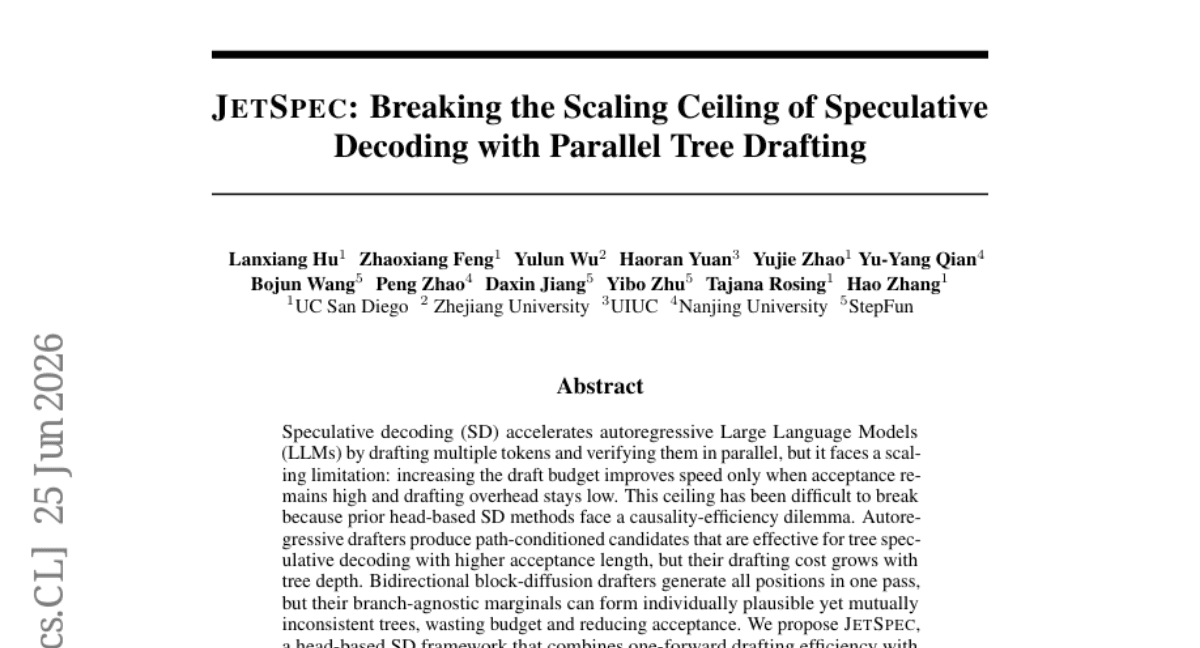
Speculative decoding (SD) has become a go-to technique for speeding up autoregressive large language models (LLMs). The idea is straightforward: draft multiple tokens in parallel, then verify them all at once, rather than generating one token at a time. But there's a catch. Scaling up the draft budget, the number of tokens produced in each draft step, has historically hit a wall. Speed gains only materialize when acceptance rates stay high and drafting overhead remains low. Two dominant approaches in head-based SD each come with their own drawbacks, creating what the researchers behind JetSpec call the causality-efficiency dilemma.
Autoregressive drafters produce path-conditioned candidates that perform well in tree speculative decoding, achieving higher acceptance lengths. The downside? Drafting cost grows linearly with tree depth, which caps efficiency. Bidirectional block-diffusion drafters, on the other hand, generate all positions in a single forward pass. Their branch-agnostic marginals, however, can form individually plausible but mutually inconsistent trees. That wastes budget and drags down acceptance rates.
JetSpec, detailed in a paper submitted to arXiv on June 16, 2026, proposes a head-based SD framework that sidesteps this trade-off. The core innovation is a causal parallel draft head trained over fused hidden states from the frozen target model. Unlike earlier methods, JetSpec produces candidate trees whose scores line up with the target model's autoregressive factorization. That alignment lets the framework convert larger draft budgets into longer accepted prefixes and higher end-to-end speedups.
Technical Architecture
JetSpec works by attaching a lightweight draft head to a frozen, pre-trained LLM. The draft head takes fused hidden states from multiple layers of the target model as input and outputs a tree of candidate tokens. The critical design choice is enforcing causal conditioning across branches: each token in the draft tree is conditioned on the path that leads to it, mirroring the autoregressive nature of the target model's inference. This ensures the tree maintains internal consistency, unlike the branch-agnostic outputs of block-diffusion methods.
The draft head is trained jointly with a verification mechanism that rejects inconsistent branches. Training involves minimizing a loss function that balances draft acceptance length with computational cost. Once trained, the head can be used for inference with no additional overhead beyond the single forward pass needed for hidden state fusion.
Benchmark Results
The research team evaluated JetSpec on dense and Mixture-of-Experts (MoE) variants of Qwen3 models across three benchmarks: mathematics (MATH-500), coding (HumanEval), and open-ended conversation (MT-Bench). On NVIDIA H100 GPUs, JetSpec achieved up to 9.64x speedup on MATH-500 compared to standard autoregressive decoding. On open-ended conversational workloads, the speedup reached 4.58x. These gains held up across both dense and MoE architectures, with JetSpec outperforming bidirectional-head and tree-based SD baselines in every configuration.
Further latency gains were demonstrated through integration with vLLM, a popular open-source inference serving library. Under realistic serving loads, JetSpec reduced tail latencies by up to 60% compared to baseline speculative decoding methods, a clear sign of its practical viability for production deployments.
Implications for LLM Deployment
The ability to accelerate inference without sacrificing quality is crucial as LLMs find their way into real-time applications like chatbots, code assistants, and interactive tutoring systems. JetSpec tackles a fundamental bottleneck: the trade-off between draft quality and computational efficiency. By making the draft process both fast and causally consistent, it unlocks the potential for larger draft budgets, which directly translate into faster generation.
The framework's reliance on head-based methods also means it can be applied to existing LLMs without modifying the core model architecture. That's a practical advantage: organizations can upgrade inference speed without retraining or replacing their deployed models.
Code and Availability
The JetSpec code and models are open-sourced under a permissive license at https://github.com/hao-ai-lab/JetSpec. A project page with additional visualizations and documentation is live at https://jetspec-project.github.io/jetspec-web/. The project has received 27 upvotes on Hugging Face as of the paper's submission.
"Our code and models are available at this https URL," the authors note in the paper, emphasizing their commitment to reproducibility and community adoption.
Conclusion
JetSpec marks a meaningful step forward in speculative decoding, breaking the scaling ceiling that constrained earlier methods. By resolving the causality-efficiency dilemma through a causal parallel draft head, it achieves significant speedups across diverse benchmarks and model architectures. As demand for faster LLM inference continues to grow, frameworks like JetSpec will be essential for making advanced AI systems practical at scale.