Silicon Revolution
How Open-Source RISC-V Is Disrupting the Processor Market and Reshaping Hardware Design
RISC-V's open-source model is challenging Arm and x86 dominance across multiple markets. From Chinese server chips to European automotive AI, the ecosystem is maturing rapidly. This analysis explores the technical, economic, and geopolitical forces driving adoption.
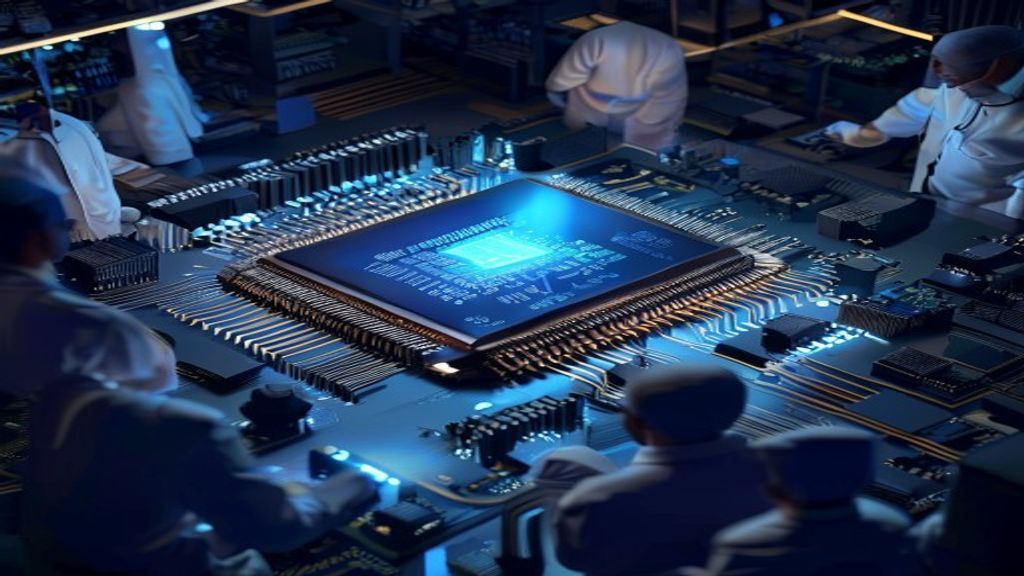
For decades, the processor market was a duopoly. Intel's x86 architecture ruled PCs and servers. Arm's licensed cores dominated mobile and embedded systems. The barriers to entry were impossibly high: designing a competitive CPU required billions in investment, decades of patent thickets, and access to advanced fabrication. The open-source RISC-V instruction set architecture (ISA) is dismantling those barriers one layer at a time.
First proposed in 2010 at UC Berkeley, RISC-V (pronounced 'risk-five') is a free and open ISA that anyone can use to design chips without paying royalties or signing non-disclosure agreements. Unlike Arm, which charges per-chip licenses, or x86, which is tightly controlled by Intel and AMD, RISC-V belongs to the community. Today, the RISC-V International foundation counts over 4,000 members, including Google, NVIDIA, Qualcomm, and the Chinese government.
Why Now? The Perfect Storm of Tailwinds
Three factors have converged to propel RISC-V from hobbyist curiosity to serious commercial contender. First, the end of Dennard scaling and Moore's Law means that general-purpose CPUs no longer deliver automatic performance gains with each new process node. Domain-specific accelerators, custom chips designed for AI, networking, or storage, are increasingly the only path to better performance per watt. RISC-V's modular design makes it ideal for creating such specialized cores.
Second, geopolitical fragmentation has made technology sovereignty a priority for many nations. The US-China trade war and subsequent export controls on advanced chips have prompted Chinese companies to accelerate their adoption of RISC-V, which is not subject to US export restrictions. 'RISC-V gives us a path to independence from both Intel and Arm,' said a senior engineer at a Chinese semiconductor startup. 'We can design our own CPUs for AI inference, 5G base stations, and even supercomputers without worrying about sanctions.'
Third, the explosion of AI at the edge, in IoT devices, cameras, robots, and sensors, demands ultra-low-power compute that traditional architectures struggle to deliver. RISC-V's extensibility allows designers to add custom instructions for neural network operations, achieving dramatic efficiency gains versus a fixed ISA.
Commercial Milestones: From Microcontrollers to Data Centers
The most visible signs of RISC-V's arrival are commercial product announcements. In 2024, Espressif Systems launched a line of Wi-Fi and Bluetooth microcontrollers built around a RISC-V core, competing directly with Arm-based ESP32 chips. The Chinese company Alibaba has developed the Xuantie series of RISC-V processors, used in its cloud data centers and edge devices. Perhaps most strikingly, Ventana Microsystems announced a high-performance RISC-V server chip that claims to match Intel Xeon performance on cloud workloads while consuming 30% less power.
In the AI accelerator space, Tenstorrent, led by legendary chip architect Jim Keller, has released a RISC-V-based AI processor that directly challenges NVIDIA's proprietary CUDA ecosystem. 'The industry is tired of being locked into a single architecture,' Keller said at a recent conference. 'RISC-V allows us to innovate at the ISA level, not just the microarchitecture level.'
Software Ecosystem: The Remaining Hurdle
Hardware is only half the battle. For RISC-V to challenge x86 and Arm in mainstream computing, it needs a mature software ecosystem. The Linux kernel has supported RISC-V since version 5.19, and major distributions like Debian, Fedora, and Ubuntu now offer official RISC-V ports. LLVM and GCC compilers are mature. The Android Open Source Project has experimental RISC-V support, though Google has not yet made it a tier-1 target.
The biggest gap is in developer tools and debuggers. 'You can compile C code for RISC-V and run it,' a software engineer at a European automotive Tier-1 supplier noted. 'But try to profile performance or debug a race condition, and you'll find the toolchain much less polished than for Arm. That's where we need the community to invest.' Companies like IAR Systems and SEGGER have begun offering commercial toolchains, signaling growing confidence in the ecosystem.
Geopolitical Stakes: The US-China Dimension
RISC-V sits at the intersection of technology and geopolitics. The US government has expressed concern that Chinese companies could use RISC-V to circumvent export controls on advanced CPU designs. In response, RISC-V International has strengthened its governance to ensure the standard remains truly open and neutral, with technical committees representing members from all countries equally.
Europe has embraced RISC-V as a strategic tool for digital sovereignty. The European Processor Initiative, which aims to build a homegrown supercomputing chip, has adopted RISC-V as its baseline ISA. Germany's Federal Ministry of Education and Research recently funded a €50 million project to develop open-source RISC-V cores for automotive and industrial applications. 'We cannot rely on US or Asian chip designs for our most critical infrastructure,' a European Commission official told sevennews. 'RISC-V is the foundation for a truly European semiconductor ecosystem.'
What the Future Holds
RISC-V is unlikely to displace x86 in high-end desktops or Arm in smartphones within the next five years. The software inertia and performance optimizations accumulated over decades are formidable. But in the exploding markets of AI inference at the edge, custom SoCs for IoT, and sovereign cloud infrastructure, RISC-V is already the architecture of choice for many new designs.
As the cost of designing custom chips continues to fall, thanks to open-source EDA tools, standardized chiplet interfaces (UCIe), and multi-project wafer runs, the value proposition of an open ISA becomes harder to ignore. RISC-V's ultimate legacy may not be as a replacement for existing architectures, but as the catalyst for a new era of hardware democratization, where anyone with a good idea and a decent budget can design a chip tailored to their exact needs.