AI Benchmarks
GPT-5.4 Leads the 2026 Math Benchmark Pack as Frontier Scores Saturate
GPT-5.4 edges out rivals with a sweep of the top competition-math rows, but GPT-5.2 Pro ties every cell and GPT-5.3 Codex offers nearly identical scores at lower cost. The real differentiator: how models perform on next-generation benchmarks like FrontierMath and HMMT Feb 2026.
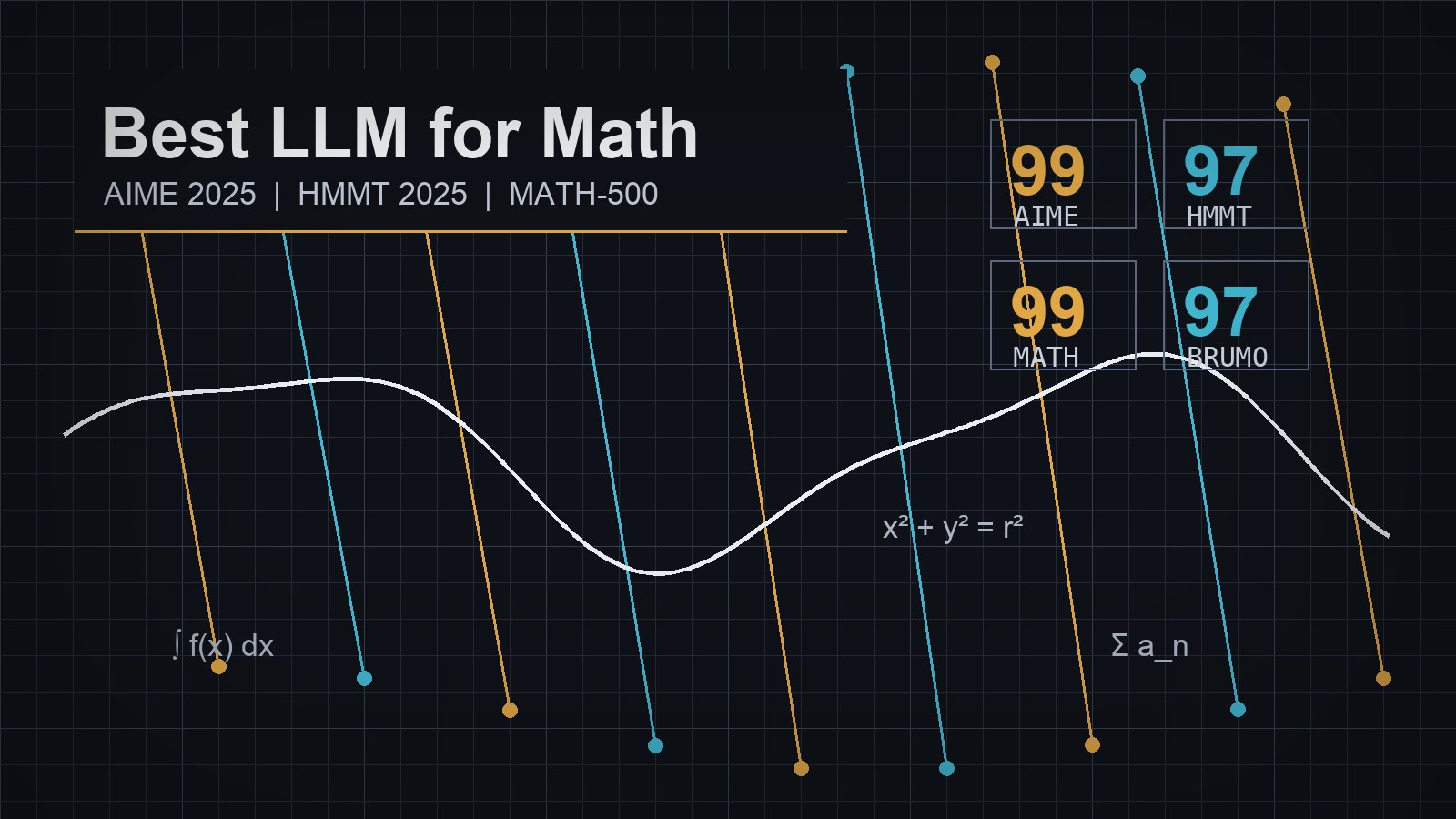
The math benchmark landscape for large language models has hit an inflection point. OpenAI's GPT-5.4 leads the BenchLM.ai math leaderboard with scores of 99 on AIME 2025, 99 on MATH-500, and 97 on BRUMO 2025. Yet GPT-5.2 Pro matches every one of those scores, and GPT-5.3 Codex is close behind at 98/99/96 across the same rows. Claude Opus 4.6 is right there too, at 98/98/96.
This saturation at the top is not a sign of stagnation. It signals that the old benchmarks have been conquered. The models that lead today are those with the strongest coverage across multiple competition-style and general-difficulty math sets, while sidestepping the contamination traps that plague single-year evaluations.
Saturated Benchmarks and the Contamination Check
BenchLM tracks AIME 2023, 2024, and 2025 alongside HMMT 2023–2025, MATH-500, and the newer BRUMO 2025. The logic is simple: a model that scores 99 on AIME 2023 but drops to 45 on AIME 2025 likely memorized older public problems rather than developing generalizable math reasoning. The frontier models in the current table show consistent performance across all three years, which is strong evidence of genuine reasoning capability rather than benchmark recall.
The top 10 models cluster between 96 and 99 on both AIME 2025 and HMMT 2025. At this level, a 1- or 2-point gap is statistically negligible for most practical workflows. The meaningful separation now happens on the next-generation test suite.
The Next Generation: FrontierMath and HMMT Feb 2026
OpenAI's GPT-5.5 and GPT-5.5 Pro, released April 23, 2026, and DeepSeek's V4 Pro series, released April 24, do not report scores on the older BenchLM rows. Instead, they have moved to harder evaluations: FrontierMath, HMMT Feb 2026, IMOAnswerBench, and APEX.
GPT-5.5 Pro scores 52.4 on FrontierMath, and GPT-5.5 scores 51.7. DeepSeek V4 Pro Max reaches 95.2 on HMMT Feb 2026, 89.8 on IMOAnswerBench, and 38.3 on APEX. These numbers cannot be directly compared to the older benchmarks, FrontierMath is designed to be research-grade hard, where even the strongest models solve roughly half the problems.
The headline takeaway: labs are aware that the old tests are saturated and have moved the goalposts. For users who need a model today for practical competition or applied math, GPT-5.4 or Claude Opus 4.6 are safe picks. For research-grade math, GPT-5.5 Pro's FrontierMath row is the capability ceiling to watch.
Use-Case Recommendations
The best model depends heavily on the task. For competition-style problems requiring step-by-step reasoning on hard algebra, number theory, probability, and geometry, GPT-5.4 or GPT-5.2 Pro are the defaults at 99 on AIME 2025 and 97 on HMMT 2025. Claude Opus 4.6 and Grok 4.1 are essentially tied for practical use.
For scientific computing and applied math, calculus, linear algebra, differential equations, GPT-5.3 Codex is the value pick. It combines a 98 on AIME 2025 with 99 on MATH-500 and strong symbolic manipulation for coding-adjacent workflows. Claude Opus 4.6 is the alternative when readable derivations matter more than throughput.
For finance and probabilistic reasoning, the priority shifts from raw accuracy to auditability. GPT-5.4 and Claude Opus 4.6 handle probability and estimation reliably when prompted to show assumptions and expose uncertainty. The numerical hallucination rate matters more than peak AIME score here.
For math tutoring, explanation quality becomes the primary metric. Claude Opus 4.6 and Claude Sonnet 4.6 produce clearer step-by-step explanations. GPT-5.4 is stronger when the student needs multiple solution paths or a verification pass. No model is 100% reliable, every output should be spot-checked.
Pricing and Value
Pricing changes the recommendation more than the top-line math score. GPT-5.4 costs $2.50 per million input tokens and $15.00 per million output tokens. GPT-5.3 Codex costs the same input but $10.00 output. Claude Opus 4.6 is more expensive at $5.00/$25.00, while Claude Sonnet 4.6 is $3.00/$15.00.
For a few hard problems, GPT-5.4 or Claude Opus 4.6 justify the premium. For a high-volume math assistant, GPT-5.3 Codex provides enough benchmark headroom, nearly identical MATH-500, one point behind on AIME, at significantly lower output cost.
Open-Weight Alternatives
Among open-weight models, GLM-5 (Reasoning) from Z.AI scores 98 on AIME 2025, 95 on HMMT 2025, and 92 on MATH-500, making it the strongest open option for competition-math. Kimi K2.5 (Reasoning) from Moonshot AI follows with 96.1/95.4/92 across the same rows. DeepSeek-R1 remains strong on MATH-500 at 97.3 but trails badly on current competition-math: 45 on AIME 2025, 41 on HMMT 2025, and 43 on BRUMO 2025. Sarvam 105B is worth noting for MATH-500 specifically, scoring 98.6 despite weaker coverage elsewhere.
The Verdict
GPT-5.4 is the best fully covered LLM for math in 2026, but the race is too tight for a single winner. GPT-5.2 Pro ties it, GPT-5.3 Codex is the value pick, and Claude Opus 4.6 is the best choice when explanation quality matters. The next frontier is not on the old benchmarks but on FrontierMath and HMMT Feb 2026, where GPT-5.5 Pro currently leads. For today's practical math work, the safe picks are clear, and the real signal is in the use case, not the headline rank.
Data from BenchLM.ai. Last updated May 2026.