AI Model Release
MiniMax launches M2.7 model with strong software engineering and office productivity skills
MiniMax's M2.7 model delivers strong results in software engineering benchmarks and professional office tasks, with a 97% skill adherence rate on complex instructions and an ELO score of 1495 on GDPval-AA.
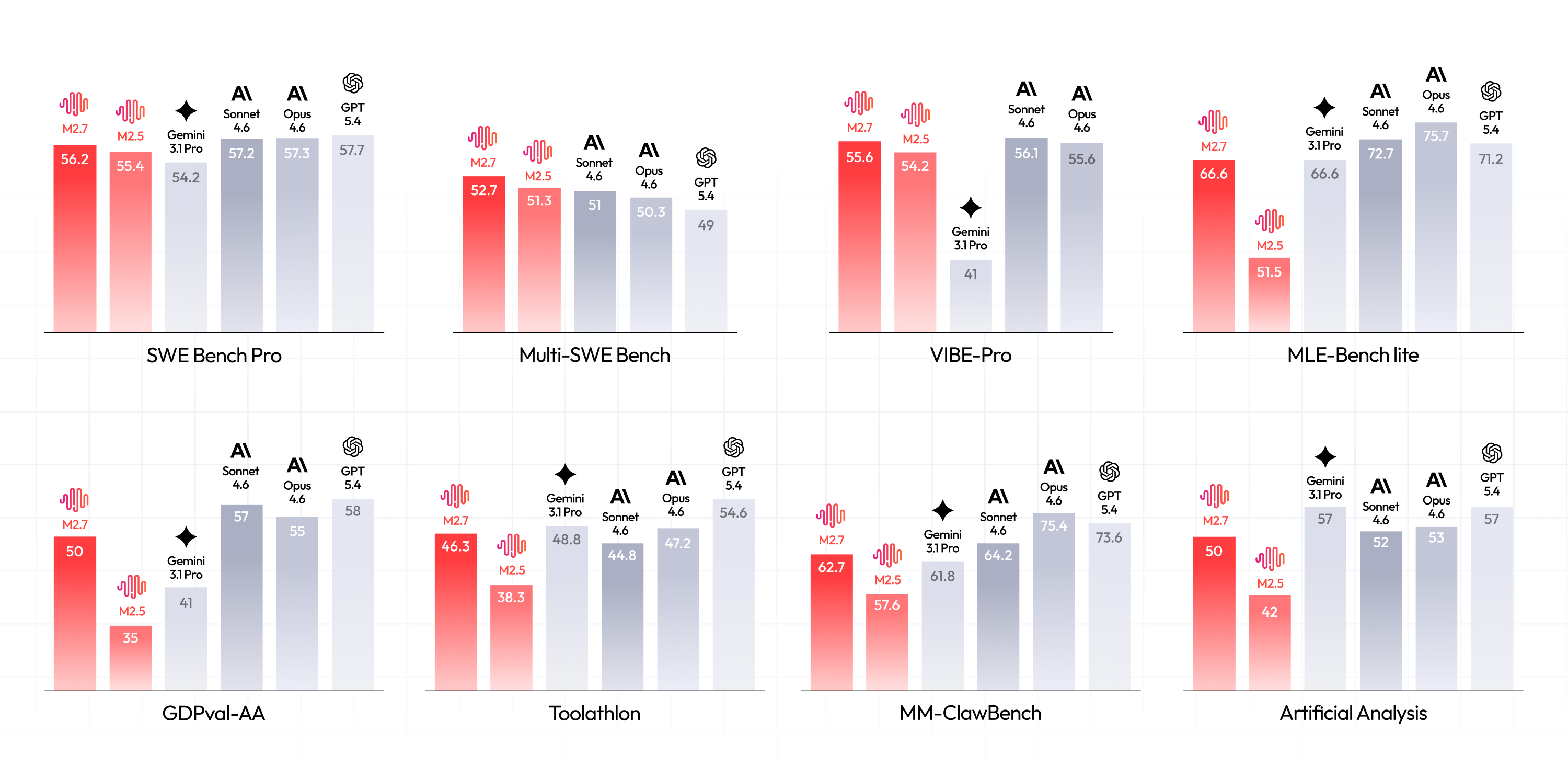
MiniMax has dropped M2.7, a new large language model that brings real gains in software engineering, office productivity, and complex environment interaction. It is built to handle end-to-end project delivery, bug analysis, code security review, and machine learning tasks, the kinds of jobs that trip up lesser models.
Benchmark performance
On the SWE-Pro benchmark, M2.7 hit 56.22%, nearly matching the best Opus-level scores out there. That capability extends to end-to-end project delivery, where it posted a VIBE-Pro score of 55.6%, and to deep understanding of complex engineering systems, where it scored 57.0% on Terminal Bench 2.
In professional office tasks, the model earned an ELO of 1495 on GDPval-AA, the highest among open-source models. M2.7 shows significantly improved complex editing abilities across the Microsoft Office suite, including Excel, PowerPoint, and Word. It can handle multi-round revisions and high-fidelity edits without losing its way.
Engineering and interaction capabilities
M2.7 also demonstrates strong abilities in interacting with complex environments. The model maintains a 97% skill adherence rate on 40 complex skills that each require more than 2,000 tokens. In OpenClaw evaluations, M2.7 shows notable improvements over its predecessor M2.5, and in MMClaw benchmarks it approaches the performance of the latest Sonnet 4.6.
The model also features strong identity retention and emotional intelligence, a foundation for interactive entertainment applications that go beyond purely productive use.
API availability
M2.7 is available via API in two versions: M2.7 and M2.7-highspeed, with identical results. The high-speed option delivers faster inference. Both versions support automatic caching with no additional configuration required.