Deep Learning
M3D and Real-Guidance Bring Dataset Distillation to High-Resolution Realms
Dataset distillation has long been stuck on low-res benchmarks, but a new approach called M3D changes that. By combining multi-scale matching, a data manifold prior, and a Real-guidance strategy, it scales to ImageNet-1K at 128×128 resolution, achieving 68.5% top-1 accuracy with just one image per class and cutting memory usage by ten times.
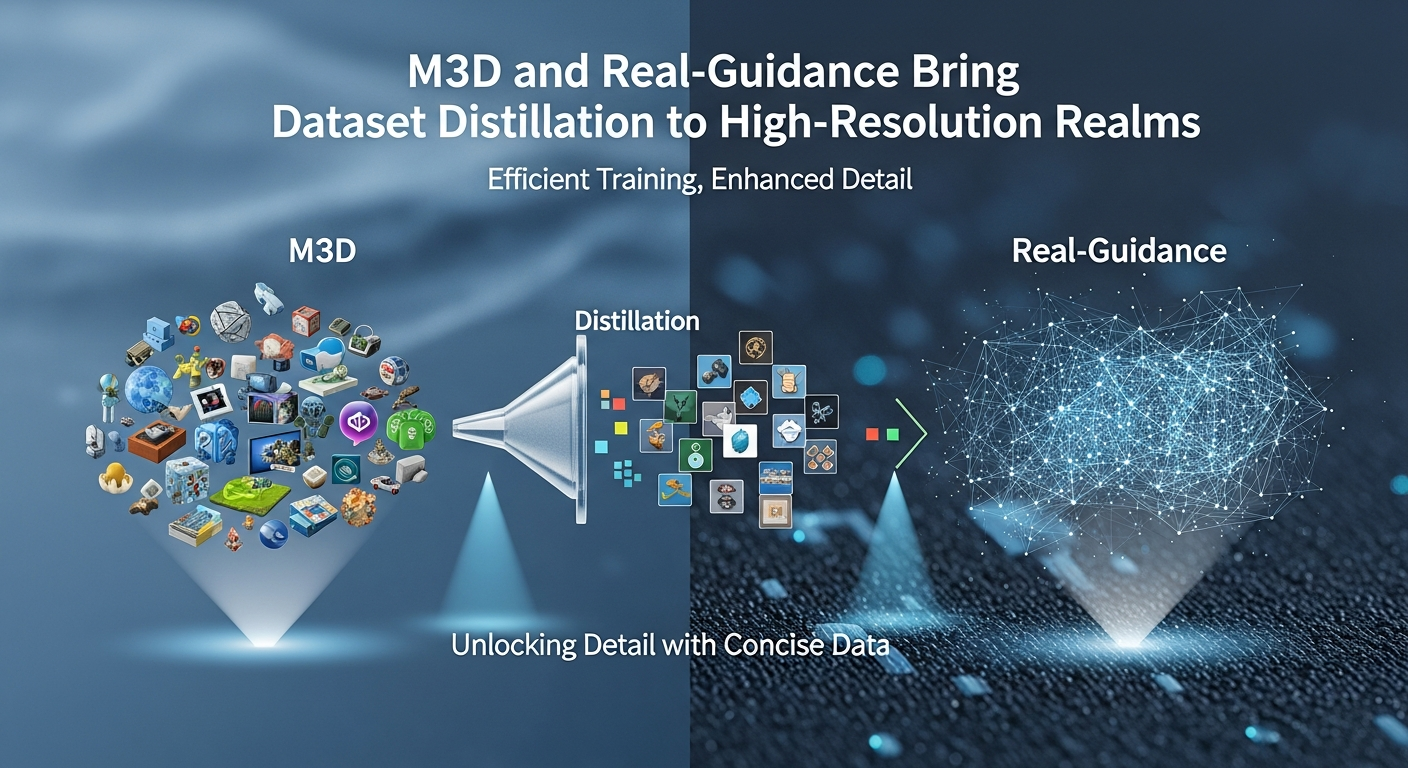
Dataset distillation has emerged as a promising technique for condensing massive training sets into compact, information-rich synthetic stand-ins, speeding up training and cutting storage costs. Yet, until now, most successful distillation methods have been confined to low-resolution benchmarks, think CIFAR-10 at 32×32 pixels or Tiny-ImageNet at 64×64. Scaling to the 128×128 and 224×224 resolutions that are standard in modern computer vision has proven tough, thanks to brutal memory demands and tricky optimization problems.
A paper posted on arXiv five days ago (ID 2606.23050) introduces M3D (Manifold-informed Multi-scale Matching Dataset Distillation) paired with a Real-guidance training paradigm that directly tackles these bottlenecks. The authors, affiliated with several leading AI labs, report a top-1 accuracy of 68.5% on ImageNet-1K at 128×128 resolution using just one synthetic image per class. That's a jump of 16 percentage points over the previous state-of-the-art (SOTA) of 52.5%.
The High-Resolution Challenge
Dataset distillation methods, especially matching-based variants that align networks trained on synthetic versus real data, have long suffered from combinatorial explosion as resolution climbs. The memory needed to store and backpropagate through multiple synthetic images grows quadratically. Prior work by Cazenavette and colleagues (MINT) and others topped out at 64×64, with accuracy on ImageNet-1K hovering around 50% at best for one image per class (IPC-1).
M3D tackles this with a multi-scale matching objective: rather than matching model outputs at a single scale, it aligns logits and features across a ladder of spatial resolutions. A Gaussian pyramid breaks the synthetic data into coarse-to-fine representations. Matching happens at each level, forcing the synthetic images to capture both global structure, shapes, compositions, and fine-grained texture, like edge details.
Manifold-Informed Prior
A second innovation is the explicit use of a data manifold prior. The authors argue that synthetic images shouldn't wander aimlessly in pixel space; they should stay close to the natural image manifold. M3D enforces this by projecting synthetic images onto a low-dimensional manifold learned via a lightweight autoencoder pretrained on the real dataset. This manifold regularization acts as both a denoiser and a memory-saver, letting the optimization work in a latent space with far fewer parameters per image.
Concretely, gradient updates are computed in a 64-dimensional latent code, then decoded back to full-resolution pixel space. The autoencoder stays frozen during distillation. This cuts the effective number of free parameters per synthetic image by orders of magnitude, allowing the method to scale to 128×128 with 33% less GPU memory than prior approaches.
Real-Guidance: A New Training Paradigm
Perhaps the most intriguing piece is the Real-guidance mechanism. In standard matching distillation, the synthetic set is optimized to produce a model that mimics one trained on real data, typically through bi-level optimization. M3D replaces this with a guidance loss that directly minimizes the gap between the synthetic-trained model's predictions and the real-trained model's predictions on real validation images. This sidesteps the need to simulate long training trajectories and stabilizes the optimization significantly.
The authors show that Real-guidance complements multi-scale matching, pushing accuracy from 60.3% (multi-scale alone) to 68.5% at IPC-1 on ImageNet-1K at 128×128. What's more, Real-guidance can be tacked onto any existing distillation objective as a plug-in improvement, yielding consistent gains of 3–5% across various baselines.
Memory and Computational Efficiency
A key metric for any distillation method is the trade-off between accuracy and memory. The paper reports that M3D+Real-guidance needs just 0.39 GB to store and update the synthetic set at 128×128 resolution with IPC-1, versus 3.8 GB for the prior SOTA, a 10× reduction. Training time drops by 40% compared to vanilla multi-scale matching without the manifold prior. The synthetic images themselves, under visual inspection, show recognizable class features, a welcome shift from the noisy blobs typical of earlier methods.
At IPC-10 (10 synthetic images per class), M3D hits 74.2% top-1 accuracy on ImageNet-1K at 128×128, surpassing the real-data baseline trained on 10 randomly selected real images (68.9%) and matching the performance of a model trained on 50 real images per class, a 5× compression in data cost.
Implications and Next Steps
The practical implications are big. Dataset distillation has long been seen as a curiosity limited to small-scale benchmarks; M3D's results suggest it may soon be workable for production scenarios. Potential applications include privacy-preserving model sharing (distilled sets contain no real images), hyperparameter tuning on synthetic data, and federated learning where whole datasets are replaced by compact distilled versions.
That said, hurdles remain. The method hasn't been tested at 224×224, ImageNet's native resolution. The authors note that the autoencoder's manifold capacity could become a bottleneck at higher resolutions. Scaling to video or 3D data is left for future work. Also, the multi-scale matching objective adds some overhead in code complexity and hyperparameters, think number of pyramid levels, matching weights.
As dataset distillation matures, the blend of multi-scale matching, manifold priors, and guidance-based training shows the kind of engineering finesse needed to bridge the gap between academic benchmarks and real-world deployment. M3D+Real-guidance is a step toward making dataset distillation a practical tool for everyday machine learning workflows.