OpenAI vs Anthropic
OpenAI just made its agent bet explicit, and Claude is stuck in single-player mode
With workspace agents, OpenAI makes its enterprise bet explicit: persistent, shared AI workers that run in the cloud and integrate with Slack. Anthropic's Claude, focused on single-session reasoning, has no answer yet.
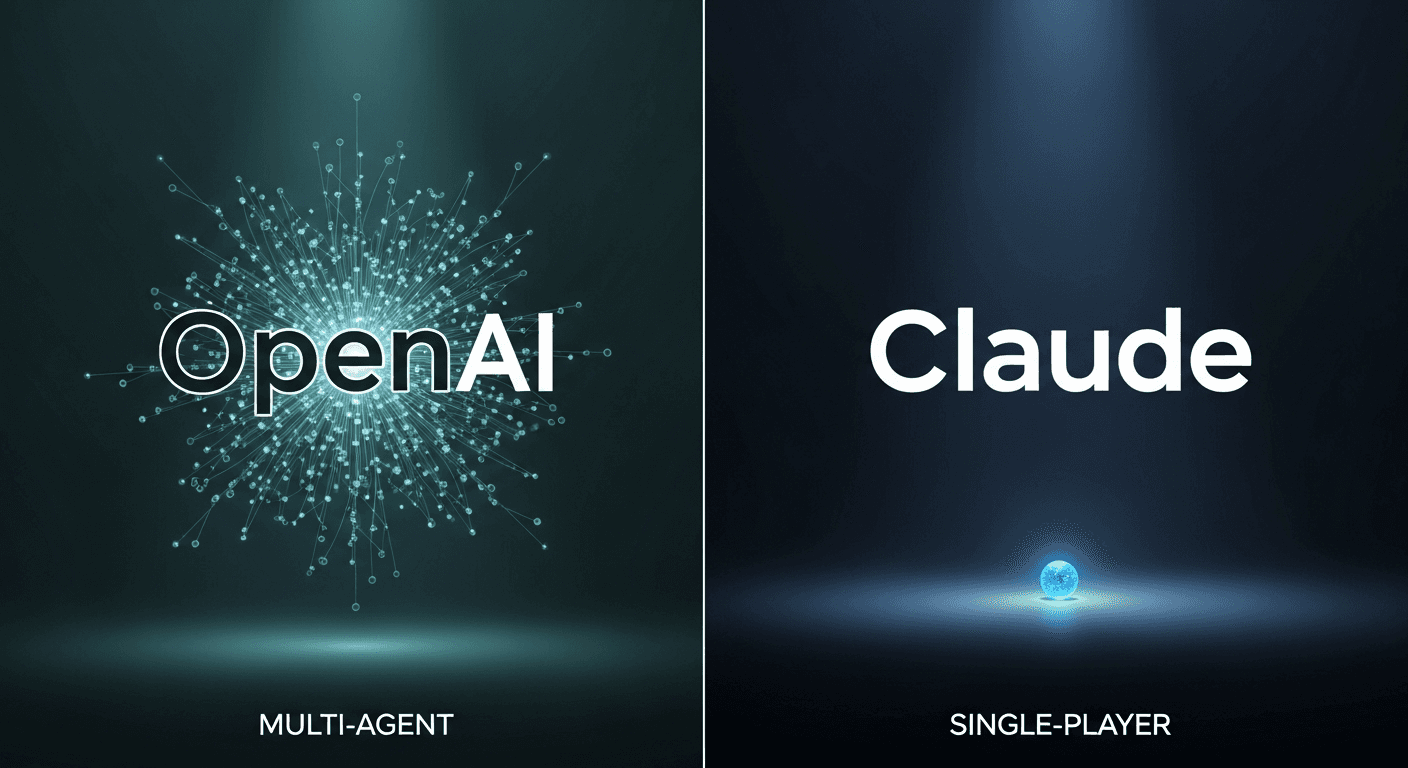
On April 22, 2026, OpenAI launched workspace agents, a new capability inside ChatGPT that lets teams create, share, and operate persistent AI agents powered by Codex. These agents execute long-running workflows in the cloud, integrate with Slack and other tools, and sit behind enterprise-grade admin dashboards that monitor everything. That announcement signals a clear strategic bet: the future of enterprise AI is not about better chat, but about delegated, shared, and governed agents that run independently of any one user. The quietest shift in enterprise AI this year is a bet…
Workspace agents in detail
Unlike the GPTs that came before them, workspace agents are always-on. They execute in the cloud, can be triggered on a schedule, and retain memory of past interactions. They can be shared across an entire organization through a dedicated library in the ChatGPT sidebar and dropped directly into Slack channels. Each agent is assembled by describing the desired workflow in natural language. ChatGPT then generates the steps, connects the tools, and handles testing.
OpenAI provided several concrete examples: a software request vetter that cross-references approved tools and policies, a product feedback router that monitors Slack and support channels, a weekly metrics report generator, a lead prospecting agent that updates the CRM, and a third-party risk manager that evaluates vendor exposure. In each case, the agent does what previously required manual coordination across tools and people.
The pricing model is also telling: workspace agents are free until May 6, 2026, then shift to a credit-based system. That structure implies usage-based billing, a model that rewards sustained, multi-step tasks rather than single-turn queries. OpenManus just killed the invite wall for AI agents.…
Where Claude stands today
Anthropic's Claude has earned strong reviews for its reasoning depth, safety handling, and long-context capabilities. But its enterprise offering, Claude for Work, remains centered on individual interactions rather than shared, persistent agents. Users can upload documents, engage in long conversations, and use Claude's tool-calling abilities within a single session. There is no native equivalent of the workspace agent library, no shared agent memory across team members, and no cloud-based persistent execution that outlives the user's session. Anthropic Launches Claude Sonnet 5: A New Frontier in…
Anthropic has made early moves toward agent-like behavior. The Computer Use feature lets Claude control a desktop interface, and Artifacts allow persistent code or documents within a conversation. But these are not multi-step, multi-tool, multi-user agents. They are enhancements to a single chat thread, not independent digital workers you can schedule, share, and govern. Anthropic launches Claude Tag on Slack for team-wide AI…
The gap is most visible in administration and governance. OpenAI's workspace agents include an API Compliance endpoint that logs every agent's configuration, updates, and executions, visible to admins who can suspend agents if needed. Claude for Work offers organization-level controls for user permissions and data retention, but no equivalent fine-grained oversight of agent-level behavior. Then again, there are no agents to oversee.
Architectural differences, not just feature gaps
This is not simply a case of Anthropic shipping features slower. The underlying architectural choices diverge meaningfully. OpenAI's Codex, the foundation of workspace agents, is a model specialized for code generation and execution. The agent infrastructure wraps it with a cloud execution environment, tool integrations, and persistent memory. That stack is purpose-built for continuous, autonomous task execution. The subtle trap waiting for AI agents in production
Claude, by contrast, is optimized for deep reasoning within a single context window. Its strength is decomposing a complex prompt across multiple steps, not persisting and orchestrating those steps across days, teams, and external triggers. Anthropic has not announced a cloud execution environment analogous to what OpenAI is shipping. The company has focused on making its models safer and more capable per query, a valid strategy, but one that leaves the door open for competitors to own the organizational agent layer. These researchers found a way to make AI agents think…
What this means for enterprises
For companies evaluating AI platforms, the choice is becoming less about model quality and more about infrastructure and integration. An organization that wants AI to handle cross-departmental workflows, routing feedback from support to product, qualifying leads from CRM to email, now has a direct path to do so with OpenAI's workspace agents, using familiar tools like Slack and ChatGPT. Anthropic and DXC Technology Launch Global Alliance to…
Anthropic's Claude offers strong reasoning and safety, but building similar multi-user, persistent workflows requires custom engineering: writing orchestration logic, managing state, connecting to enterprise APIs, and building admin dashboards. That is not impossible, but it is expensive. The advantage of a platform approach is that these capabilities come out of the box.
The risk for Anthropic is that once enterprises invest in building workflows on an agent platform, switching costs become high. OpenAI is betting that workspace agents will become the connective tissue of the AI-powered organization, and that the ability to create, share, and govern agents will be the deciding factor in platform lock-in.
Anthropic may still respond with its own agent framework, but the clock is ticking. The workspace agent era has begun, and Claude is not yet in the race.