AI in Education
The AI Learning Trap: What a 26,000-Student Study Reveals About Cognitive Debt in Education
A 26,000-student study, an MIT brain-imaging experiment, and new OECD research converge on the same finding: generative AI raises homework scores while quietly eroding exam performance and neural engagement, unless teaching is redesigned around it.
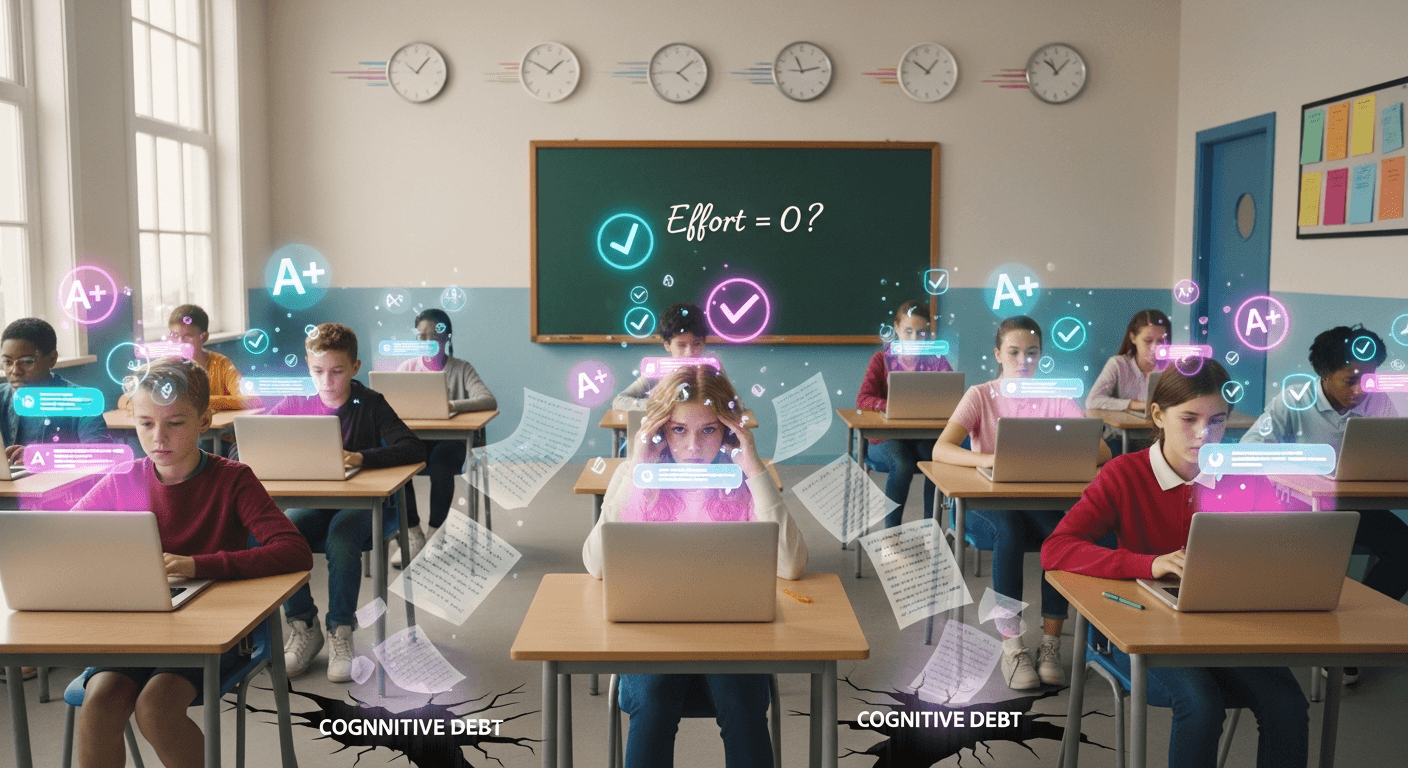
The headline numbers look like a win for AI in the classroom. Homework scores up. Completion time down. Adoption rates climbing fast, with 85% of teachers and 86% of students reporting AI use in the past school year. But look past the homework grade book, and the picture gets a lot less flattering.
The 26,000-student warning
The clearest evidence yet comes from a large-scale study that tracked 26,811 secondary students in China across grades 7 through 12 over 30 months. Students who used generative AI for homework finished assignments about 30% faster and scored 18% higher on those assignments. Six months later, their monthly exam scores had fallen roughly 20%. After nearly two years of AI use, entrance exam scores were down between 18% and 24%.
The damage was not evenly spread. Social science subjects like politics and geography saw the steepest declines, around 27%, followed by STEM at 22%, English at 17%, and Chinese at 9%. Researchers estimate that about 80% of student AI users showed a pattern of outsourcing thinking: finishing fast, scoring well on the AI-assisted work, then underperforming the moment the tool was unavailable.
Crucially, the study also found a control group that used AI without harm. Students who spent roughly the same amount of time on homework as their non-AI classmates scored just as well on exams, while still posting better homework grades. The determining factor was not whether students used AI, but whether they used it to shortcut the thinking or to supplement it.
What is happening inside the brain
A widely circulated MIT Media Lab study adds a physiological layer to that finding. Researchers split participants into three groups, tools like ChatGPT, a search engine, or brain only, and had each write essays across several sessions while recording brain activity with EEG. Brain-only writers showed the strongest and most distributed neural connectivity. Search engine users came in second. ChatGPT users showed the weakest engagement of the three.
The behavioral data reinforced the neural findings. Participants who used the AI assistant reported the lowest sense of ownership over their own essays and struggled to accurately quote lines they had supposedly just written. The researchers coined a term for the pattern: cognitive debt, a short-term convenience that appears to compound into a longer-term deficit the more it is used.
Critical thinking, redefined or eroded?
Separate research applying Bloom's taxonomy, the standard framework for classifying levels of learning from basic recall to evaluation and synthesis, found that AI assistance produces its biggest gains at the lowest cognitive tiers. It is genuinely useful for memorization and fact retrieval. Its usefulness drops off sharply at the higher-order tasks, analysis, evaluation, original synthesis, that education is ultimately supposed to cultivate.
Some researchers argue this is not simply erosion but a shift. Studies of cognitive offloading, the practice of delegating mental tasks to an external tool, describe critical thinking moving toward new skills: verifying AI output, integrating machine-generated responses into original work, and stewarding a task rather than executing it start to finish. Whether that constitutes a real substitute for the deep cognitive engagement it replaces remains contested.
Faculty appear to be watching the shift with concern rather than curiosity. In a 2026 EDUCAUSE survey of 438 faculty and staff, 73% said they had personally handled an academic integrity issue tied to student AI use, and 83% predicted that AI would decrease students' attention spans.
The pedagogy variable
Findings from the OECD's Digital Education Outlook 2026 point to a way out of the trap, but a narrow one. Generative AI can support learning, the organization concludes, but only when guided by clear teaching principles. Left to run without pedagogical structure, AI tools tend to outsource the task itself rather than build the skill the task was designed to teach. That distinction, structured use versus unstructured delegation, echoes almost exactly what the 26,000-student study found on the ground: same tool, opposite outcomes, depending on how it was integrated into the work.
That puts an unusual amount of weight on teacher training and assignment design, areas that have historically lagged behind the technology they are meant to govern. A chatbot can be deployed to a classroom in an afternoon. Redesigning assessment to make cognitive offloading harder to hide takes considerably longer, and most school systems have not caught up.
Open questions
The research converging in 2026 does not answer whether AI belongs in classrooms, only that the current default mode of use, fast answers with little friction, appears to trade short-term performance for long-term capability. What remains unresolved is whether the "cognitive debt" documented at the individual level will compound into a measurable skills gap at the workforce level a decade from now, whether assessment systems can be redesigned fast enough to close the loophole the 26,000-student study exposed, and whether the productive, offloading-resistant use of AI that the OECD describes can scale beyond well-resourced schools with the staff and time to implement it carefully.