Open source
The first open-source web agent that doesn't need HTML just beat GPT-4o
MolmoWeb agents, available in 4B and 8B sizes, were trained on MolmoWebMix, a new dataset combining over 130,000 synthetic and human demonstrations. They surpass closed models and set new standards for open web agent research.
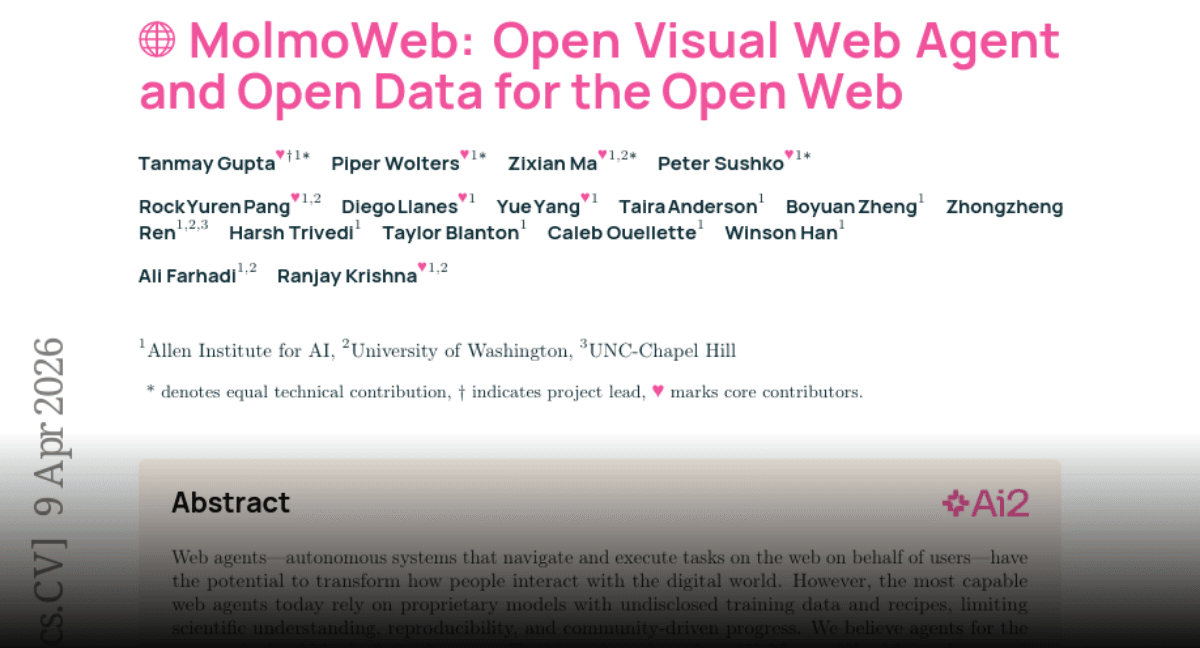
A team of researchers released MolmoWeb, a family of fully open multimodal web agents. The agents achieve state-of-the-art results on browser-based benchmarks, beating proprietary models like GPT-4o. They do not require access to HTML, accessibility trees, or specialized APIs. Ai2 cracked open every drawer in the AI cabinet, here's…
The agents come in 4-billion- and 8-billion-parameter sizes. They were trained on a dataset called MolmoWebMix that combines more than 100,000 synthetic task trajectories from multiple generation pipelines with over 30,000 human demonstrations, atomic web-skill trajectories, and GUI perception data including referring expression grounding and screenshot question answering.
State-of-the-art performance
On browser-use benchmarks such as WebVoyager, Online-Mind2Web, and DeepShop, MolmoWeb agents achieve state-of-the-art results, outperforming similar-scale open-weight-only models including Fara-7B, UI-Tars-1.5-7B, and Holo1-7B. Notably, MolmoWeb-8B also surpasses set-of-marks agents built on much larger closed frontier models like GPT-4o. Two AI labs just proved why open models win in…
The researchers demonstrated consistent gains through test-time scaling via parallel rollouts with best-of-N selection. On WebVoyager and Online-Mind2Web, they achieved 94.7% and 60.5% pass@4, compared to 78.2% and 35.3% pass@1.
Operating without HTML
Unlike many existing web agents that rely on parsing HTML or accessibility trees, MolmoWeb agents operate purely from screenshots. Given a task instruction and a webpage screenshot, they predict the next browser action. This makes them truly vision-based action policies. The design eliminates the need for specialized APIs and improves robustness across different web environments.
Open data and reproducibility
The team behind MolmoWeb, which builds on the earlier Molmo vision-language model, has committed to releasing model checkpoints, training data, code, and a unified evaluation harness. This stands in contrast to proprietary systems whose training data and recipes remain undisclosed, limiting scientific understanding and community-driven progress. Nvidia's data atlas shows why synthetic data matters…
We believe agents for the open web should be built in the open,
the researchers write in their paper. The release aims to accelerate open research on web agents and enable reproducibility.
Community reaction
The paper attracted immediate attention from the AI research community. The Librarian Bot on Hugging Face identified several related papers, including OpAgent: Operator Agent for Web Navigation and WebFactory: Automated Compression of Foundational Language Intelligence into Grounded Web Agents, both from 2026, suggesting growing momentum in the open web agent space. OpenManus just killed the invite wall for AI agents.…
Industry observers noted that the ability to match or exceed proprietary model performance at a fraction of the compute cost and with full transparency could pressure larger labs to reconsider their closed approaches.
MolmoWeb-8B is now available for download and experimentation. The full dataset and codebase are expected in the coming weeks.